


A secure border helps keep the population safe from various criminal threats while allowing for the legal movement of people and goods across the border. With this in mind, States must work together to address major issues, such as drug and firearms trafficking, and irregular migration.
Canada–United States Border Security
Canada and the United States share the longest continuous, non-militarized land border in the world, and have the most comprehensive bilateral trade relationship. Every day, billions of dollars in goods and hundreds of thousands of people cross the border between the two countries. Thus, to ensure the security of this border, ongoing collaboration is required between both States, supported by agreements such as the 2001 Smart Border Declaration and the 2011 Action Plan.
In Canada, border security is a responsibility shared between the Canada Border Services Agency (CBSA), responsible for border security at ports of entry and inland offices, and the Royal Canadian Mounted Police (RCMP), responsible for border security between official ports of entry. The CBSA’s front line personnel includes approximately 8,500 uniformed employees who ensure security at 1,200 ports of entry by land, air, rail and marine in Canada.
The RCMP, as the national police service, administers a program that ensures border integrity and facilitates ongoing collaboration between government and law enforcement partners on both sides of the border. This program facilitates information sharing, joint operations and the identification, investigation and disruption of criminal activity at the border.
In the United States, U.S. Customs and Border Protection is in charge of security at official ports of entry, while the U.S. Border Patrol is responsible for securing U.S. borders between ports of entry.
Representatives from Canada and the United States meet annually at the Cross Border Crime Forum. This forum brings together law enforcement organizations from both countries to discuss security, law enforcement and information sharing partnerships to identify and respond to threats.
In addition, Canadian and United States government agencies meet at various forums to develop collaborative plans, such as the Cross Border Firearms Task Force, which has been combatting the trafficking of firearms and drug through cross-border travel and trade since 2021.
Canada’s Border Plan
In December 2024, the Government of Canada announced a plan to strengthen the country’s border security and immigration system. This Border Plan, bolstered by an investment of $1.3 billion, was expanded in February 2025 with the announcement of additional measures to better combat fentanyl trafficking, organized crime and money laundering.
The Border Plan is built upon five pillars:
- detecting and disrupting the fentanyl trade;
- introducing significant new tools for law enforcement;
- improving operational coordination;
- expanding information sharing; and
- minimizing the volume of unnecessary claims made at the border by temporary residents, asylum claimants and people who cross the border irregularly.
These pillars form the basis for concrete actions to respond to the key issues addressed below.
Detecting and Disrupting the Traffic of Fentanyl
Fentanyl, its analogues and their precursors (i.e., chemicals essential to the production of synthetic opioids) are controlled in Canada under the Controlled Drugs and Substances Act. Generally used as an analgesic in hospitals, fentanyl can enter the illegal drug market by importation, production in illegal laboratories or theft of medical products.
Although fentanyl is not the most seized drug in either Canada or the United States, this highly potent synthetic drug contributes to the high overdose rates on both sides of the border. Fentanyl is 20 to 40 times more potent than heroin and 100 times more potent than morphine. It is difficult to detect as it is odourless and tasteless.
Between 2021 and 2024, the quantity of fentanyl seized by the CBSA, at all ports of entry and exit combined, varied considerably (Figure 1). This variation is due to the nature and number of successful interceptions made by the CBSA annually. For instance, in 2024, a total of 4.1 kg of fentanyl was seized in a single interception, helping to explain the 775% increase in the quantity of fentanyl seized compared to 2023, according to the CBSA’s 2024 year in review.
Figure 1 – Total Fentanyl Seizures by the Canada Border Services Agency, in Kilograms, by Financial Year, from 2021–2022 to 2024–2025

Note: Some CBSA drug seizures are presented in greater detail in 2024 Year in review: CBSA protecting Canadians and supporting our economy.
Source: Figure prepared by the Library of Parliament using data obtained from Canada Border Services Agency, Canada Border Services Agency enforcement action statistics.
In the United States, most of the fentanyl intercepted by U.S. Customs and Border Protection is smuggled primarily in vehicles driven by U.S. citizens. U.S. Customs and Border Protection seized more fentanyl in 2023 and 2024 than in the previous five years combined. The total number of interceptions between 2021 and 2024 is divided unevenly between the various ports of entry (Figure 2).
Figure 2 – Total Number of Fentanyl Seizures by U.S. Customs and Border Protection, in Kilograms, by Region and by Financial Year, from 2021 to 2024
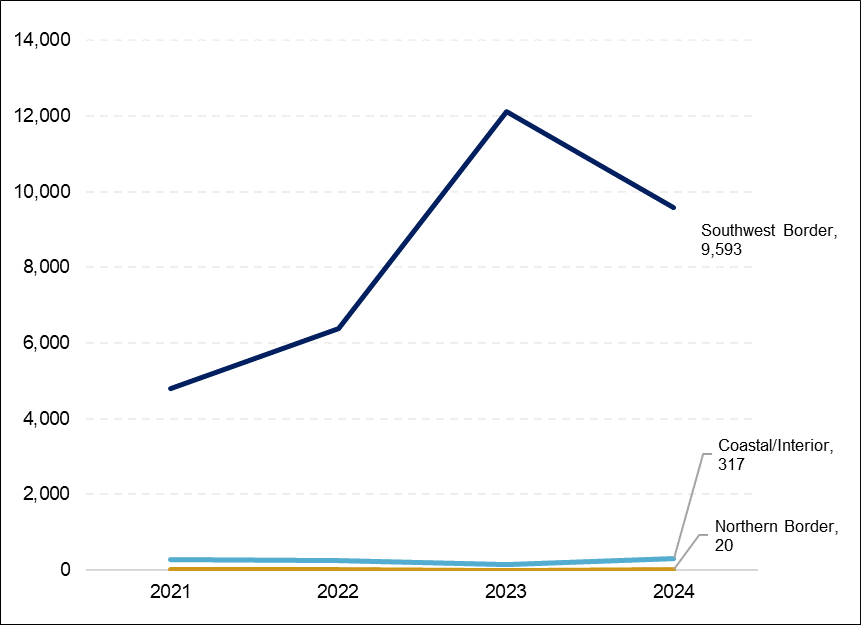
Note: It is important to note that the data for 2024 cover only the first two quarters of the financial year, from October 2023 to March 2024.
Source: Figure prepared by the Library of Parliament using data obtained from the U.S. Customs and Border Protection, Drug Seizure Statistics. Source accessed in February 2025.
Although the illegal importation of fentanyl is a concern, a calculation based on data from U.S. Customs and Border Protection shows that the quantity of fentanyl imported from Canada to the United States represents 0.2% of the agency’s total seizures. In January 2025, seizures of fentanyl from Canada had dropped by 97% compared to December 2024.
It should also be noted that drug data may be incomplete, as some drugs are never intercepted. Caution should be exercised when comparing Canadian and U.S. data. Indeed, the methods for collecting data on drug trafficking differ, as do the financial years in which the data were gathered and the policies and procedures followed to suppress drug trafficking, making comparisons difficult.
The measures in the Border Plan to combat fentanyl trafficking at the border, as well as those added in 2025, include: expanding the capacity to detect illicit drugs and their precursors at the border, training new canine teams, and creating the Canadian Drug Profiling Centre and a Precursor Chemical Risk Management Unit within Health Canada.
The Government of Canada has also signalled its intention to enhance police abilities to combat illegal drugs and precursor chemicals under the Controlled Drugs and Substances Act.
The appointment of Kevin Brosseau as the Commissioner of Canada’s Fight Against Fentanyl and the listing of cartels as terrorist entities under the Criminal Code are some of the measures taken recently.
The Government of Canada also announced a $200 million investment to increase the capacity of Public Safety Canada and of the Communications Security Establishment to gather and share intelligence on organized crime and fentanyl, in addition to launching the Canada–U.S. Joint Strike Force to combat transnational organized crime, fentanyl trafficking and money laundering.
Irregular Migration
Although irregular crossings of the Canada–U.S. border between official ports of entry are dangerous and prohibited under the immigration and customs laws of both countries, numerous migrants attempt to enter this way nonetheless.
Most attempts at irregular migration at the Canada–U.S. border involve human smugglers, who often charge thousands of dollars for their services. Irregular migrants risk getting caught in extreme weather conditions and being exploited by smugglers.
Irregular entries on both sides of the border are difficult to count, as some migrants are never intercepted. In 2024, the U.S. Border Patrol intercepted 23,721 individuals between ports of entry along the northern border, compared to 1,530,523 individuals intercepted along the southern border (Figure 3). The U.S. data do not specify how many of them applied for asylum.
Figure 3 – Number of Individuals Intercepted by the U.S. Border Patrol, by Region and by Financial Year, from 2021 to 2024
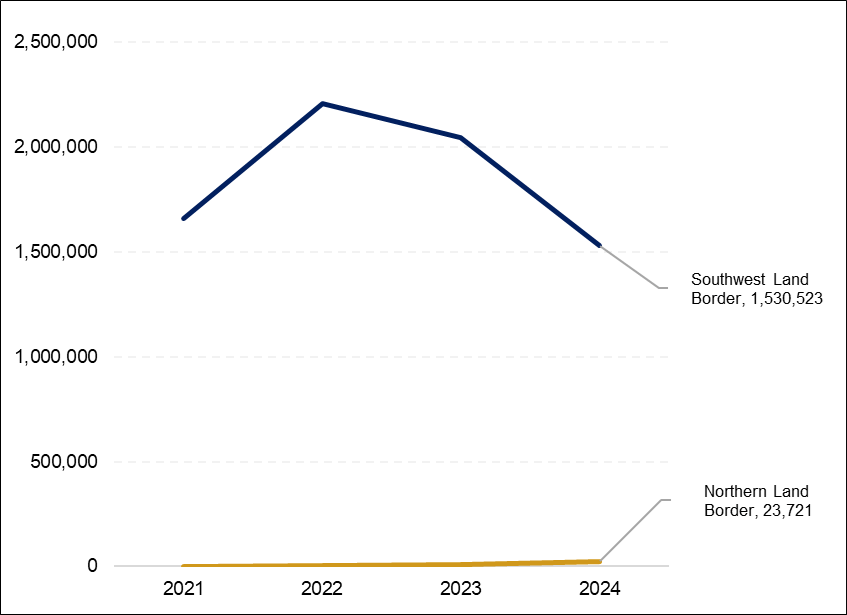
Note: Totals may not add up because data for the other area of interception have been removed from the figure for visualization purposes. In 2024, a total of 3,075 individuals were intercepted in other areas.
Source: Figure prepared by the Library of Parliament using data obtained from U.S. Customs and Border Protection, Nationwide Encounters. Source accessed very early in 2025.
In Canada, the number of people intercepted between ports of entry is estimated by the number of asylum (refugee) claims made. The foreign nationals intercepted are taken to an official port of entry so that an immigration or CBSA officer can determine their eligibility to make an asylum claim. In 2024, 1,103 asylum claims were made by people who had crossed the Canadian border irregularly.
Unless they qualify for an exception set out in the Safe Third Country Agreement between Canada and the United States, persons who cross the border cannot claim asylum, as they must do so in the first of the two countries they enter.
The Government of Canada has taken actions to strengthen Canada’s temporary residence programs and migration pathways, including reinstating a visa requirement for Mexican nationals in February 2024. This decision led to a nearly 80% decrease in asylum claims by Mexican citizens which went “from 1,997 claims in February to 434 claims in June 2024,” and a 72%-decrease in irregular crossings by Mexican nationals from Canada to the United States between 2023 and 2024.
Canada’s Border Plan and its expansion seek more specifically to reduce irregular migration along the Canada–U.S. border, particularly by ensuring constant surveillance by nearly 10,000 front-line staff members of the CBSA and RCMP.
The Government of Canada has also invested in new tools and new technologies, including two leased Black Hawk helicopters, 60 new drones and mobile surveillance towers.
To reduce the volume of applications at the border, the Government of Canada has signalled its intention to impose restrictions on countries that do not facilitate the rapid return of their citizens in the event of a fraudulent entry or a removal. It also plans to grant CBSA officers additional powers, particularly to cancel temporary resident documents in cases of non-compliance. According to the 2024 Fall Economic Statement, streamlining the intake, processing and adjudication of asylum claims will help uphold the integrity and fairness of the asylum system.
According to a list of actions and outcomes to date to secure the Canada–United States border published by the Government of Canada, the number of irregular asylum claims in Canada fell by 77% in 2024 compared with the same period in 2023.
Additional Resources
Béchard, Julie and Robert Mason. Refugee Protection in Canada, Publication No. 2020-50-E, Library of Parliament, 30 July 2020.
Chesoi, Madalina, Robert Mason and Philippe A. Gagnon. Overview of the Canada–United States Safe Third Country Agreement, Publication No. 2020-70-E, Library of Parliament, 1 September 2023.
Ercolao, Marc and Andrew Foran. Setting the Record Straight on Canada-U.S. Trade, 21 January 2025.
By Sabrina Charland and Alexsandra Ferland, Library of Parliament