


Health research refers broadly to all research related to health, health systems or health care delivery. Funding for health research in Canada comes from a variety of sources such as the federal government, provincial and territorial governments, higher education institutions such as universities, industry – including companies in the health sector – and non-governmental organizations such as health-related charities.
Federal Funding Sources
Federal Granting Bodies
The Canadian Institutes of Health Research (CIHR) is the primary source of federal funding for health research. CIHR provides funding for biomedical, clinical, health systems and services, and population health research. Figure 1 shows CIHR funding by primary research theme between 2006–2007 and 2025–2026.
Figure 1 – Canadian Institutes of Health Research Funding by Primary Research Theme, 2006–2007 to 2025–2026 ($ millions)


Source: Figure prepared by the Library of Parliament using data obtained from the Canadian Institutes of Health Research, CIHR in Numbers.
Through its 13 virtual institutes, CIHR funds investigator-initiated research and priority-driven research in areas identified by the federal government. The organization also provides funding for graduate students and postdoctoral fellows during their research training. Figure 2 shows CIHR awards by funding type from 2006–2007 to 2025–2026.
Figure 2 – Funding Awarded by the Canadian Institutes of Health Research, by Funding Type, 2006–2007 to 2025–2026 ($ millions)


Source: Figure prepared by the Library of Parliament using data obtained from the Canadian Institutes of Health Research, CIHR in Numbers.
CIHR’s budget increased significantly in 2020–2021 following the increased need for priority-driven research related to the COVID‑19 pandemic. From March 2020 to October 2022, CIHR invested $414 million in over 965 COVID-19 research projects in areas such as diagnostics, treatments, public health responses and communication strategies.
In February 2021, CIHR released its Strategic Plan 2021-2031. During that period, the organization plans to focus on developing a more inclusive concept of health research in five priority areas:
- advancing research excellence in all its diversity;
- strengthening Canadian health research capacity;
- accelerating the self-determination of Indigenous peoples in health research;
- pursuing health equity through research; and
- integrating evidence in health decisions.
While CIHR is the largest contributor to federal health research funding, other federal granting agencies also contribute. CIHR, the Natural Sciences and Engineering Research Council of Canada, and the Social Sciences and Humanities Research Council constitute Canada’s three federal granting agencies, and they collaborate to provide interagency research funding. In accordance with their respective legislative mandates, all three granting agencies focus entirely on funding extramural research (research conducted outside these agencies). Two of the largest programs offered by the three granting agencies are the Canada Research Chairs Program and the New Frontiers in Research Fund. In addition, the Canada Biomedical Research Fund is administered by the Social Sciences and Humanities Research Council on behalf of the three agencies. Launched in 2022–2023 with a budget of $250 million over four years, the Fund aims to support high-risk applied research, as well as training and talent development to support Canada’s biomanufacturing capacity.
Other Departments and Agencies
- The National Research Council of Canada (NRC) conducts intramural research at 12 research centres, and it also participates in some collaborative projects. Among NRC research programs, several focus on health and are primarily carried out at two of its research centres: the Human Health Therapeutics Research Centre (which includes several facilities) and the Medical Devices Research Centre. The NRC, through its Industrial Research Assistance Program, also provides financial support to small- and medium-sized businesses for extramural, technology-driven research, including in the health sector.
- The Public Health Agency of Canada’s (PHAC’s) National Microbiology Laboratory (NML) investigates existing and emerging infectious diseases. NML researches the characteristics of pathogens, including how they are transmitted and ways to detect infection (i.e., diagnostics), and develops treatments and vaccines. PHAC and Health Canada contribute to various types of research projects, including intramural research activities, extramural research activities in collaboration with outside researchers, research activities conducted by unaffiliated researchers using Health Canada or PHAC premises and extramural research activities that have been contracted out.
- The Strategic Response Fund (SRF), administered by Innovation, Science and Economic Development Canada, replaced the Strategic Innovation Fund (SIF) in 2025. Announced in Budget 2017, the SIF was created to simplify and consolidate existing innovative technology programs. The SRF pursues the same mandate while prioritizing industries affected by trade disruptions and tariffs, large-scale innovation in key sectors such as biomanufacturing and life sciences, and artificial intelligence infrastructure.
Not-for-Profit Corporations
- Genome Canada was established in 2000 to fund genomics-related research in health, among other areas. Together with provincial governments and other stakeholders, the organization co-funds large-scale scientific projects, leading-edge technologies, and transformative programs and initiatives through six regional genome centres across the country.
- Created in 1997, the Canada Foundation for Innovation (CFI) funds research infrastructure such as the laboratories, equipment, buildings and databases required to conduct research. Similar to Genome Canada’s funding, CFI funding is not limited to health and includes a broad range of applications. CFI receives $5.13 billion in federal support over 15 years, beginning in 2018–2019, including an ongoing amount of up to $450.55 million per year beginning in 2023–2024.
A Comparison of Spending on Health Research in Canada and Selected Countries
Statistics Canada publishes data on total federal spending on science and technology by socio-economic objective, including health (see Figure 3). While these data do not cover all health-related research – such as health policy research – they capture most federal spending on health-related research and development.
Figure 3 – Federal Spending on Health-Related Research and Development 2015–2016 to 2024–2025 ($ millions)


Source: Figure prepared by the Library of Parliament using data obtained from Statistics Canada, “Table 27-10-0014-01: Federal expenditures on science and technology, by socio-economic objectives,” Database, accessed 29 September 2026.
The World Health Organization’s Global Observatory on Health Research and Development analyzes international data collected by the Organisation for Economic Co-operation and Development and the United Nations Educational, Scientific and Cultural Organization to identify health research and development priorities based on public health needs. Figure 4 shows the amount of annual biomedical research grants provided by the major public funders of health research in selected countries. Even after accounting for population differences among countries, the United States (U.S.) is the largest public funder of health research globally. The data also suggest that Canada, in comparison with other countries and regions, and taking into account population size, is a major public funder of health research.
Figure 4 – Annual Grants for Biomedical Research by Funding Organization in Selected Countries, 2023 (US$ millions)
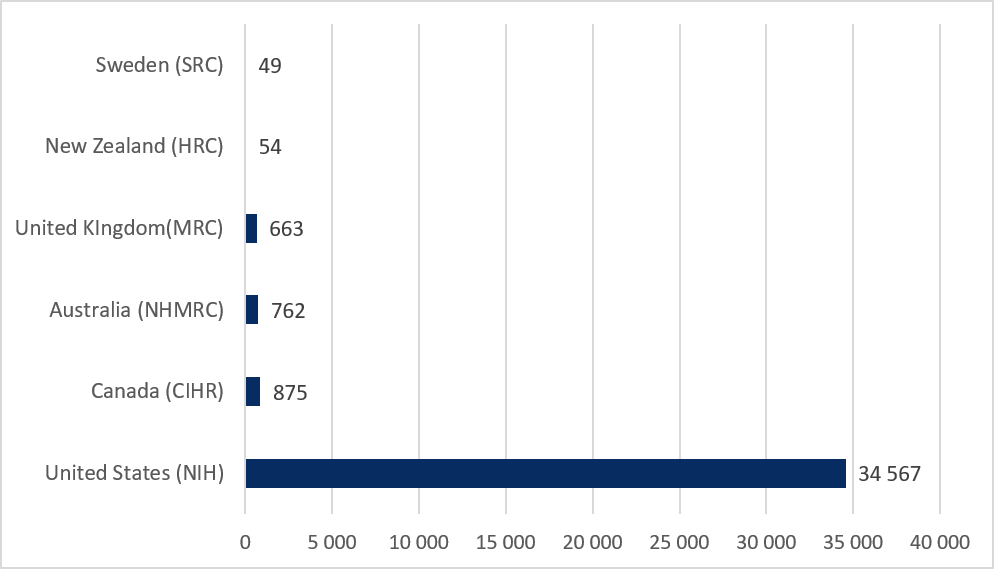
Note: SRC (Swedish Research Council); HRC (Health Research Council); MRC (Medical Research Council); NHMRC (National Health and Medical Research Council); CIHR (Canadian Institutes of Health Research); and NIH (National Institutes of Health).
Source: Figure prepared by the Library of Parliament using data obtained from the World Health Organization, Global Observatory on Health Research and Development, “A. Annual grant amount by funder,” Investments on grants for biomedical research by funder, type of grant, health category and recipient.
International Collaboration
Published online by the U.S. National Institutes of Health, World RePORT, is an interactive, open-access database and interactive map of global research investments from some of the world’s largest biomedical research funding organizations. A review of the database reveals that many investments involve global collaborations. For example, in 2024, CIHR funded 40 projects involving international partnerships. The proportion of CIHR grants (both in number of grants and amounts awarded) with international linkages has been increasing since the organization’s creation in 2000 and amounts to 15% of the total number of grants in 2025–2026. CIHR explains that international collaboration promotes access for Canadian researchers to international expertise, technologies and facilities, while global health research focuses on such topics as the impacts of globalization, health equity and transnational risks.
Additional Resources
Canadian Association for Neuroscience. Science funding in Canada – Statistics, 2024.
Canadian Institutes of Health Research. 2024-25 Departmental Results Report.
Innovation, Science and Economic Development Canada. Canada’s Biomanufacturing and Life Sciences Strategy.
By Camille De La Durantaye-Guillard, Library of Parliament
This publication is based on an earlier Library of Parliament publication by Sonya Norris.