


More than 80 percent of Canadians live in cities and towns, while the remaining population is spread across the country’s vast rural and remote areas. These rural communities represent a demographic with unique characteristics, contributions and challenges.
The term “urban” generally relates to a town or city, while “rural” refers to the countryside. The two concepts are interdependent and the distinctions between them have never been simple. Furthermore, many departments within the Government of Canada use their own interpretations of these terms, adding to the complexity of establishing a uniform definition.
This HillNote focuses specifically on the definitions of “urban,” “rural” and “remoteness” according to Statistics Canada. A clear understanding of these statistical definitions and classifications is crucial to identifying the target populations for relevant government initiatives and policies. This paper also features various maps to illustrate the differences between these definitions.
The Population Centre and Rural Area Classification
The Population Centre and Rural Area Classification is Statistics Canada’s departmental standard for classifying urban and rural areas. Population centres are areas that have a population of at least 1,000 and a density of 400 or more people per square kilometre. Figure 1 displays all the population centres in Canada. According to the Population Centre and Rural Area Classification, areas in purple are urban, while all others are classified as rural areas. According to the 2021 Census, 6.6 million people (17.8% of the population) lived in these rural areas.
Figure 1 – Population Centres in Canada, 2021

Sources: Map prepared by the Library of Parliament, 2025, using data obtained from Statistics Canada, “Table 98-10-0006-01 Population counts, for census metropolitan areas, census agglomerations, population centres and rural areas,” 9 February 2022; and Statistics Canada, “Population centres,” 2021 Census – Boundary files. Esri base maps are the intellectual property of Esri and are used under licence, © 2025 Esri and its licensors. The following software was used: ArcGIS Online. Contains information licensed under the Statistics Canada Open Licence.
Definition of “Rural and Small Town”
Statistics Canada also uses another less formal definition to determine what is rural and what is urban, namely, that of “rural and small town.” All areas within a census metropolitan area (CMA) or census agglomeration (CA) are considered urban, and all other areas are considered rural.
CMAs and CAs comprise one or more adjacent census subdivisions centred on a population centre, called the core. A census subdivision is based on an administrative unit defined by a province or territory, such as a municipality. A CMA must have a total population of at least 100,000, with a minimum of 50,000 residing in the core. The total population of a CA must be at least 10,000.
Figure 2 identifies the CMAs and CAs across Canada. According to the definition of “rural and small town,” any region that does not appear in light orange is considered rural. As of the 2021 Census, this rural population had reached nearly 6 million, or roughly 16% of the population.
Figure 2 – Canada Census Metropolitan Areas and Census Agglomerations, 2021
Sources: Map prepared by the Library of Parliament in 2025 using data obtained from Statistics Canada, “Table 98-10-0006-01 Population counts, for census metropolitan areas, census agglomerations, population centres and rural areas,” 9 February 2022; and Statistics Canada, “Census metropolitan areas and census agglomerations,” 2021 Census – Boundary files. Esri base maps are the intellectual property of Esri and are used under licence, © 2025 Esri and its licensors. The following software was used: ArcGIS Online. Contains information licensed under the Statistics Canada Open Licence.
Comparing the Two Approaches
Although it may seem counterintuitive, an area may be considered urban by one classification, but rural by another. In particular, some rural areas (non-population centres) within CMAs and CAs are considered urban according to the definition of “rural and small town.” In 2021, approximately 644,300 people lived within these rural regions. These communities are typically small towns or rural areas near larger urban centres and represent a critical subset of the rural population.
Figure 3 illustrates how population centres and CMAs or CAs overlap across Canada. The search bar can be used to locate regions in Canada and explore their rural-urban boundaries.
Figure 3 – Census Metropolitan Areas, Census Agglomerations and Population Centre Overlap, Canada, 2021
Sources: Map prepared by the Library of Parliament, 2025, using data obtained from Statistics Canada, “Table 98-10-0006-01 Population counts, for census metropolitan areas, census agglomerations, population centres and rural areas,” 9 February 2022; and Statistics Canada, “Population centres,” and “Census metropolitan areas and census agglomerations,” 2021 Census – Boundary files. Esri base maps are the intellectual property of Esri and are used under licence, © 2025 Esri and its licensors. The following software was used: ArcGIS Online. Contains information licensed under the Statistics Canada Open Licence.
Figures 4 to 6 present specific examples that highlight different parts of the country. Figure 4 shows the CA of Rouyn-Noranda, Quebec. The orange shaded area is considered urban according to the definition of “rural and small town” (e.g., within a CA), yet this same area is considered 99.5% rural according to the Population Centre and Rural Area Classification. The two population centres (Rouyn-Noranda and Évain) comprise 60.3% of the CA’s population, but only 0.5% of its area. Conversely, the Malartic population centre, east of Rouyn-Noranda, is considered rural according to the definition of “rural and small town,” but it is considered urban according to the Population Centre and Rural Area Classification.
Figure 4 – Rouyn-Noranda Census Agglomeration and Population Centre Overlap

Sources: Map prepared by the Library of Parliament, 2025, using data obtained from Statistics Canada, “Population centres” and “Census metropolitan areas and census agglomerations,” 2021 Census – Boundary files; Natural Resources Canada (NRCan), Administrative Boundaries in Canada – CanVec Series – Administrative Features, 1:1M, 1 March 2019; NRCan, Lakes, Rivers and Glaciers in Canada – CanVec Series – Hydrographic Features, 1:250K, 1 March 2019; NRCan, Transport Networks in Canada – CanVec Series – Transport Features, 1:250K, 1 March 2019. The following software was used: Esri, ArcGIS Pro, version 3.4.0. Contains information licensed under the Open Government Licence – Canada and the Statistics Canada Open Licence.
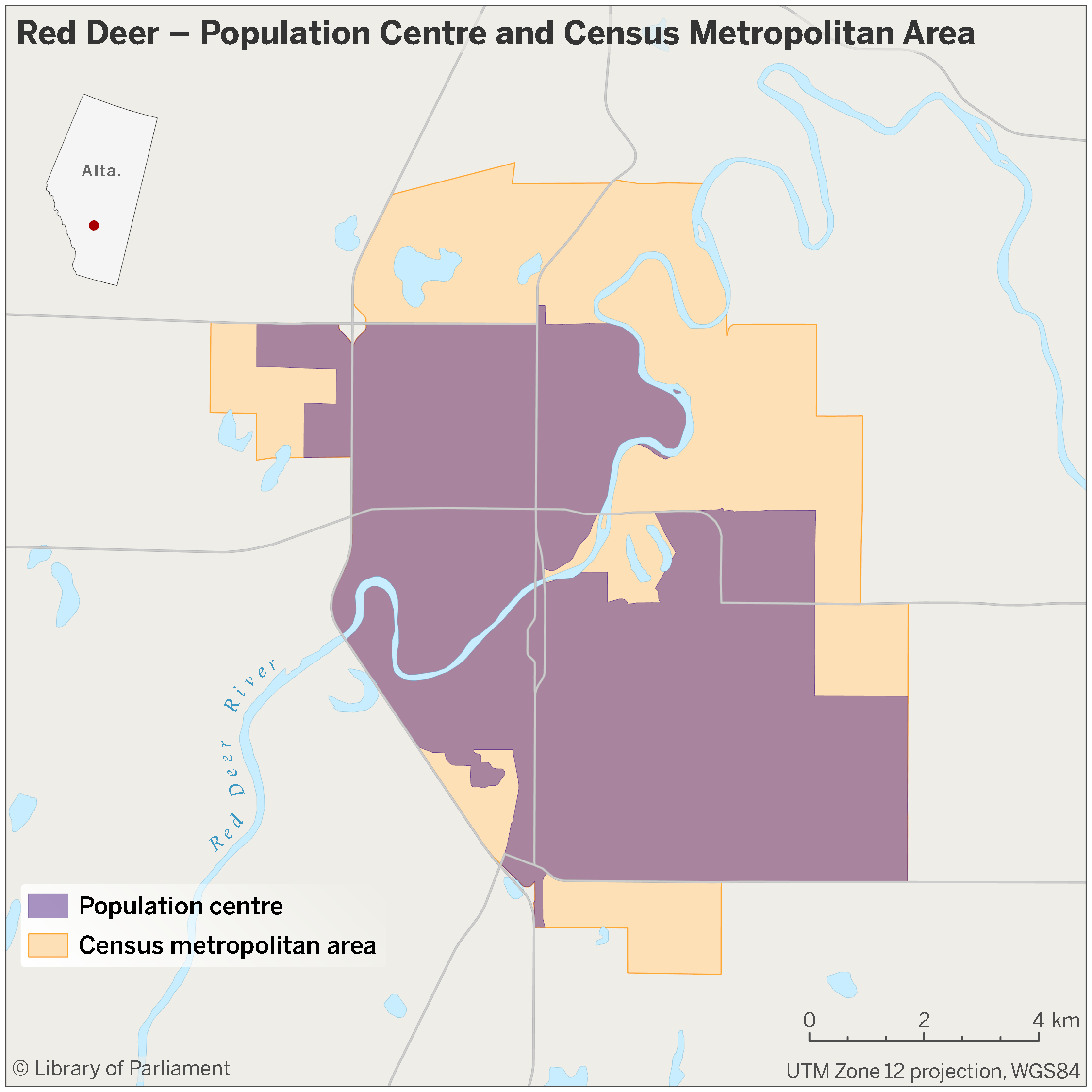
As of the 2021 Census, 62.9% of the land area in the Red Deer CMA in Alberta is classified as urban, as it is covered by the Red Deer population centre. The remaining 37.1% of the land area is rural (as shown in Figure 5). Red Deer is one of the smallest CMAs, its population of 100,844 barely surpassing the population threshold for being considered a CMA.
Figure 5 – Red Deer Census Metropolitan Area and Population Centre Overlap
Sources: Map prepared by the Library of Parliament in 2025 using data obtained from Statistics Canada, “Population centres” and “Census metropolitan areas,” 2021 Census – Boundary files; Natural Resources Canada (NRCan), Administrative Boundaries in Canada – CanVec Series – Administrative Features, 1:1M, 1 March 2019; NRCan, Lakes, Rivers and Glaciers in Canada – CanVec Series – Hydrographic Features, 1:250K, 1 March 2019; NRCan, Transport Networks in Canada – CanVec Series – Transport Features, 1:250K, 1 March 2019. The following software was used: Esri, ArcGIS Pro, version 3.4.0. Contains information licensed under the Open Government Licence – Canada and the Statistics Canada Open Licence.
Although the population of the CMA of Kamloops, British Columbia (114,142) is comparable to that of Red Deer, its land area is 98.6% rural according to the Population Centre and Rural Area classification (see Figure 6).
Figure 6 – Kamloops Census Metropolitan Area and Population Centre Overlap

Sources: Map prepared by the Library of Parliament, 2025, using data obtained from Statistics Canada, “Population centres” and “Census metropolitan areas and census agglomerations,” 2021 Census – Boundary files; Natural Resources Canada (NRCan), Administrative Boundaries in Canada – CanVec Series – Administrative Features, 1:1M, 1 March 2019; NRCan, Lakes, Rivers and Glaciers in Canada – CanVec Series – Hydrographic Features, 1:250K, 1 March 2019; NRCan, Transport Networks in Canada – CanVec Series – Transport Features, 1:250K, 1 March 2019. The following software was used: Esri, ArcGIS Pro, version 3.4.0. Contains information licensed under the Open Government Licence – Canada and the Statistics Canada Open Licence.
Canada’s Remoteness Index
Lastly, it is important to note that rurality is not experienced uniformly across Canada. Some rural communities are near urban areas where they can access more services, while others are entirely isolated. To take these distinctions into account, Statistics Canada created an index of remoteness in collaboration with Indigenous Services Canada. It measures remoteness by assigning each census subdivision a value between 0 (easily accessible) and 1 (very remote) based on geographic accessibility of services and proximity to surrounding regions. Figure 7 shows the remoteness of each census subdivision across Canada according to the 2021 Index of Remoteness. Lighter areas indicate more remote regions, while darker areas indicate more accessible regions.
Figure 7 – Remoteness Index by Census Subdivision in Canada
Source: Map prepared by the Library of Parliament, 2025, using data obtained from Statistics Canada, Index of Remoteness, 3 April 2020; and Statistics Canada, “Census subdivisions” in 2021 Census – Boundary files. Esri base maps are the intellectual property of Esri and are used under licence, © 2025 Esri and its licensors. The following software was used: ArcGIS Online. Contains information licensed under the Statistics Canada Open Licence.
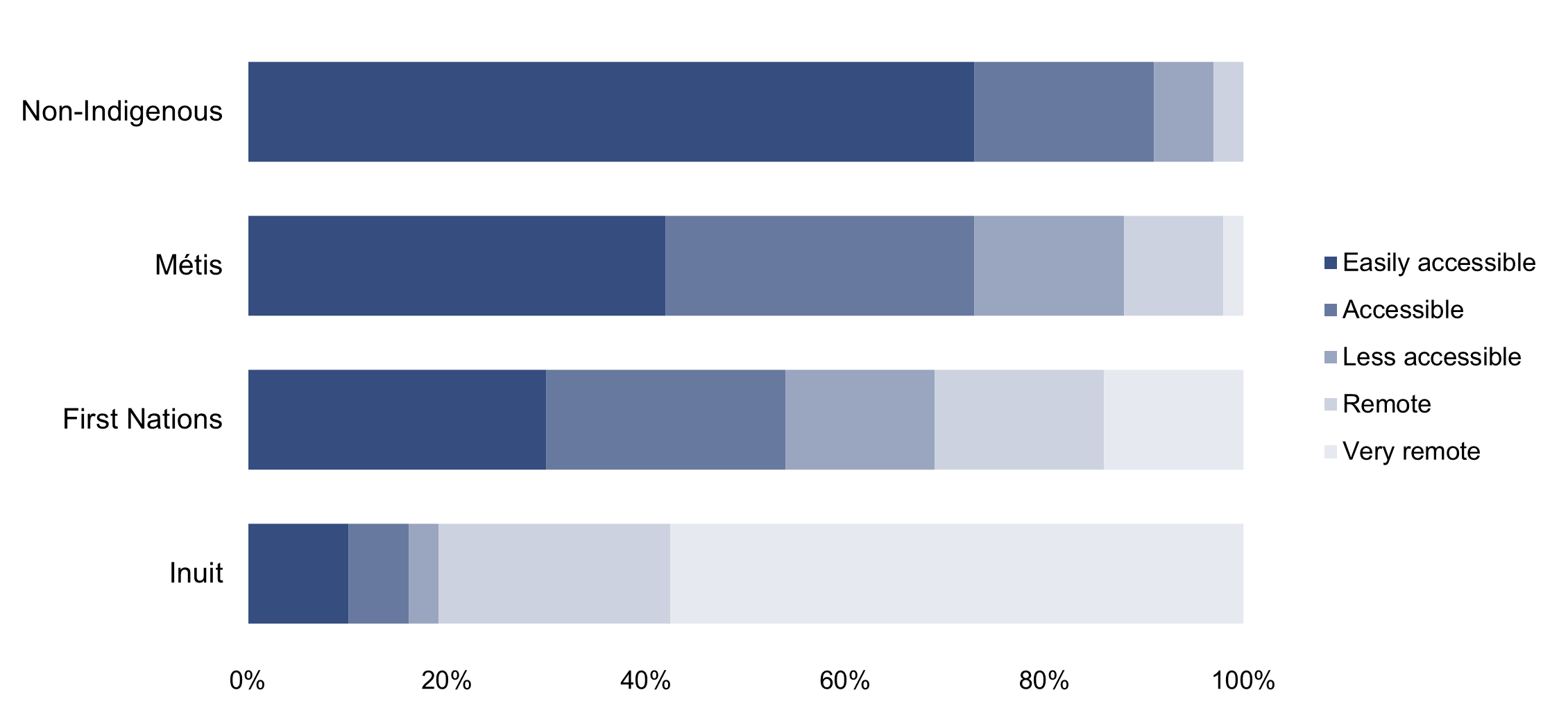
Many remote communities cannot be reached by road and have limited access to essential services, including healthcare, education, social services, emergency response services and grocery stores. Moreover, isolation can exacerbate socio-economic challenges, particularly for Indigenous peoples. Figure 8 illustrates the proportion of Indigenous and non-Indigenous people who live in remote areas, according to the Index of Remoteness. In 2016, 26% of Indigenous people (aged 19 to 45 years) lived in remote or very remote areas of Canada, whereas only 3% of the non-Indigenous population did. This difference likely originates from the historic displacement and resettlement of Indigenous peoples by the Government of Canada. Inuit were the most likely to live in very remote (57%) and remote (23%) areas.
Figure 8 – Proportion (%) of Indigenous and Non-Indigenous People, Aged 19 to 45 years, Living in Remote Areas According to the Index of Remoteness, 2016
Source: Figure prepared by the Library of Parliament, 2025, using data obtained from Statistics Canada, 2016 Census; and Jaclyn Layton, Distance as a Factor for First Nations, Métis, and Inuit High School Completion, Statistics Canada, 2023.
By Megan Barkey and Philippe Renaud, Library of Parliament