
This HillNote is the first in a series of four publications about productivity. The second in the series presents Canada’s productivity performance compared to other advanced economies. The third analyzes the main potential causes of Canada’s relatively low productivity growth, and the fourth analyzes the principal potential solutions.
As the laureate of the Nobel Prize for Economics Paul Krugman remarked in his 1997 book, The Age of Diminished Expectations, “productivity isn’t everything, but in the long run, it is almost everything.” In essence, productivity is the primary long-term driver of living standards, and improving productivity – that is, producing more goods and services with the same or fewer resources – is crucial to a country’s economic prosperity.
Although productivity is a simple concept, it is difficult to define, challenging to measure and, as Canada’s productivity growth over the past 40 years shows, difficult to improve.
Various academic, government and parliamentary studies have examined Canada’s relatively low productivity growth, its causes and potential solutions.
For example, in June 2022, the Standing Senate Committee on Banking, Commerce and the Economy (BANC) published its 4th interim report concerning business investment in Canada, which concluded that improvements in many policy areas (e.g., regulations, procurement, human capital, immigration, taxation, natural resources and innovation) are needed to encourage Canadian businesses to invest in their future growth.
In 2023, it also published, Needed: An Innovation Strategy for the Data-Driven Economy, a report that stresses the need for Canada to develop a modern intellectual property regime and a national data strategy to drive productivity growth.
What is productivity?
Simply put, productivity measures how efficiently inputs, such as labour and capital, are transformed into outputs, like goods and services. Economists distinguish between two main measures of productivity: labour productivity and total factor productivity (TFP), also known as multifactor productivity.
Labour Productivity
Labour productivity measures how efficiently working hours create goods and services. When labour productivity rises, the economy produces more outputs with the same or fewer hours of labour, reflecting improved efficiency. As Statistics Canada points out, however, labour productivity also reflects changes in capital, such as investments in machinery and infrastructure, and improvements in the production organization.
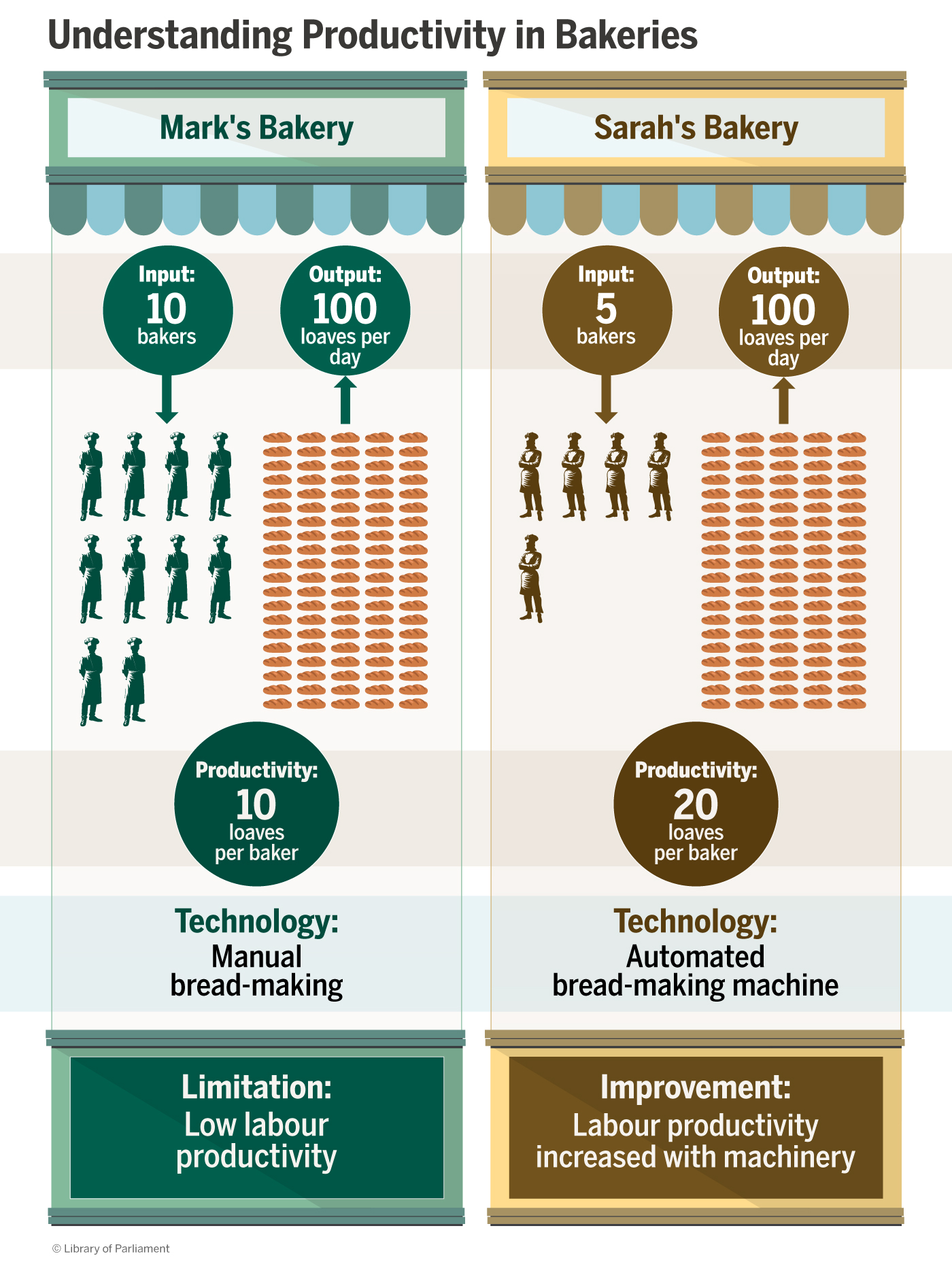
Consider this example of two bakeries: Mark’s Bakery and Sarah’s Bakery. As shown in Figure 1, Mark’s Bakery employs 10 full-time bakers to bake 100 loaves of bread per day. In contrast, Sarah’s Bakery employs five full-time bakers and, using an automated bread maker, also produces 100 loaves of bread per day. As a result, Sarah’s Bakery has double the labour productivity – it achieves the same output with half the workers.
Figure 1 – Example of Labour Productivity
Source: Figure prepared by the Library of Parliament.
This example highlights the role of capital in boosting productivity. The automated bread maker enhances labour efficiency, enabling fewer workers to produce more goods. For that reason, capital investments in physical assets like machinery and infrastructure are crucial to raising labour productivity. Research from Statistics Canada has shown that investments in intangible assets (e.g., software, data, patents, copyrights, trademarks) also contribute to labour productivity growth in Canada, albeit to a lesser extent than in the United States and Europe, which rely more heavily on intangible assets.
Total Factor Productivity
Comparing productivity across firms or industries can be misleading when they use different amounts of capital. To address this issue, economists typically use TFP, which measures how efficiently all inputs are combined to generate outputs. According to Statistics Canada, TFP is a comprehensive measure of efficiency and reflects technological innovation, improvements in production organization and economies of scale.
According to research by the International Monetary Fund (IMF), economists sometimes refer to TFP as the “measure of our ignorance,” because it captures the part of a country’s income that cannot be attributed to labour and capital which are easier to quantify. Over time economists have determined that three main variables contribute to higher TFP:
- Workforce productivity: TFP is higher in countries where workers are more educated, healthier and have access to better training;
- Resource allocation: TFP is higher in countries where the most productive firms can attract the best labour and capital;
- International trade: TFP is higher in countries that face fewer trade barriers. This is because countries specialize and use their resources more efficiently (what economists refer to as “comparative advantage”), competition is promoted and productive firms are rewarded.
What is the relationship between gross domestic product per capita, labour productivity and TFP?
Gross domestic product (GDP) per capita is calculated by dividing a country’s GDP (the total value of goods and services produced within its borders) by its population. In turn, GDP per capita growth is the sum of:
- the growth in output per hour worked (labour productivity);
- the growth in hours worked per employee (work effort); and
- the growth in the share of the population that is employed.
Increasing the latter two is only possible to a certain extent; there are a finite number of working hours in a day and a limit to the share of the population that can be employed, because it includes children and retirees, for example. Consequently, labour productivity is the main driver of long-term GDP per capita growth.
The growth rate of labour productivity is principally driven by three factors:
- Labour composition, which includes gains from education, skills, diversity and workforce changes, among others;
- Capital per worker (or capital deepening), which includes investments in physical assets (e.g., machinery, infrastructure) and intangible assets (e.g., software, data, patents, copyrights, trademarks); and
- TFP, which captures improvements in labour productivity not captured by the first two factors.
Why does productivity matter?
The same IMF research cited earlier shows that improved living standards depend on TFP growth. This is because living standards are measured as GDP per capita, and an economy cannot raise these standards by simply adding more workers. Moreover, many economic studies show that capital investments have diminishing returns.
Another laureate of the Nobel Prize for Economics, Robert Solow, who is a pioneer in the measurement of productivity growth, estimated in a seminal paper [access to the parliamentary network required] that, between 1909 and 1949, seven-eighths of U.S. labour productivity growth was due to TFP growth, while capital investment accounted for only one-eighth. This insight remains relevant [access to the parliamentary network required] today.
In a March 2024 speech, Carolyn Rogers, Senior Deputy Governor of the Bank of Canada, explained that productivity growth is a way to inoculate the economy against inflation; an economy with low productivity can grow only so quickly before aggregate demand exceeds the economy’s production capacity and inflation sets in.
Productivity is the key to long-term GDP per capita growth and higher living standards. While increasing the quantity and quality of labour and capital contributes to GDP per capita growth, sustained improvements depend on productivity growth. Technological innovation, improvements in production organization and economies of scale are the main drivers of this process in the long term.
Further Reading
Gu, Wulong. Investment Slowdown in Canada After the Mid-2000s: The Role of Competition and Intangibles. Research document by the Analytical Studies Branch Research Paper Series, Statistics Canada, 22 February 2024.
Kiarsi, Mehrab. The Importance of New Ideas in Determining Canada’s Long-Term Productivity Growth. Publication No. 2023-15-E. Library of Parliament, Ottawa, 27 November 2023.
MacGee, James and Joel Rodrigue. The Distributional Origins of the Canada-US GDP and Labour Productivity Gaps. Staff Working Paper 2024-49. Bank of Canada, 19 December 2024.
By Mehrab Kiarsi, Library of Parliament
Categories: Business, industry and trade, Economics and finance