
Under Section 94 of the Immigration and Refugee Protection Act, which came into effect 28 June 2002, the Minister of Citizenship and Immigration is required to table an annual report to Parliament on the immigration initiatives and actions of the previous year. The report to Parliament must also set the department’s targets for the number of immigrants to be admitted to Canada the following year. These targets are known as the immigration levels plan, and in 2017, a multi-year approach was adopted with the intention of developing a long-term vision for immigration. Three-year plans are now presented annually, each containing a targeted number of permanent resident admissions for each of the three years; the targets for the second and third years are forecasts and can be adjusted in the following year’s plan when the next report to Parliament is submitted.
On 24 October 2024, for the first time since reporting annually to Parliament on immigration began, the 2025–2027 immigration levels plan reduced the targets set out in the previous three-year plans. In the previous two plans, a target of 500,000 new permanent residents was set for 2025, and in the 2024–2026 plan a target of 500,000 new permanent residents was established for 2026. However, the 2025–2027 plan reduced these targets to 395,000 (a drop of 105,000) for 2025 and to 380,000 (a drop of 120,000) for 2026. This plan also sets a target for 2027 of 365,000.
Since 2017, targets for future years have been increased modestly across multiple three-year plans, but established targets have never been lowered, nor have they ever shifted this significantly up or down. This is also the first time that the three-year targets have decreasing levels year over year.
This policy change reflects Canadians’ changing views on immigration [access to the parliamentary network required]. In 2021, Canada broke its record from 1913 for the most newcomers in a year in Canadian history, then it broke the new record in 2022 and that new record in 2023. Although these record-breaking years followed the distant 184,606 permanent residents admitted in 2020 compared to its target of 341,000 for that year, by 2024, opinion polls suggested that an increasing number of Canadians felt there was too much immigration.
The overall admissions targets are broken down by immigration category. The economic class accounts for the largest segment at around 60% of the overall permanent resident admissions each year. The remaining 40% consists of family class and refugee class immigrants, and others admitted under humanitarian programs.
A number of factors are taken into consideration when developing immigration levels plans including:
- the Government of Canada’s priorities and objectives as set out in the Immigration and Refugee Protection Act and in international commitments;
- the capacity to integrate newcomers into the Canadian economy and regions across Canada;
- labour shortages;
- input from stakeholders; and
- provincial immigration interests.
The capacity to process applications in a timely manner at Immigration, Refugees and Citizenship Canada and its partner departments (in particular, Employment and Social Development Canada and the Canada Border Services Agency) is another important factor.
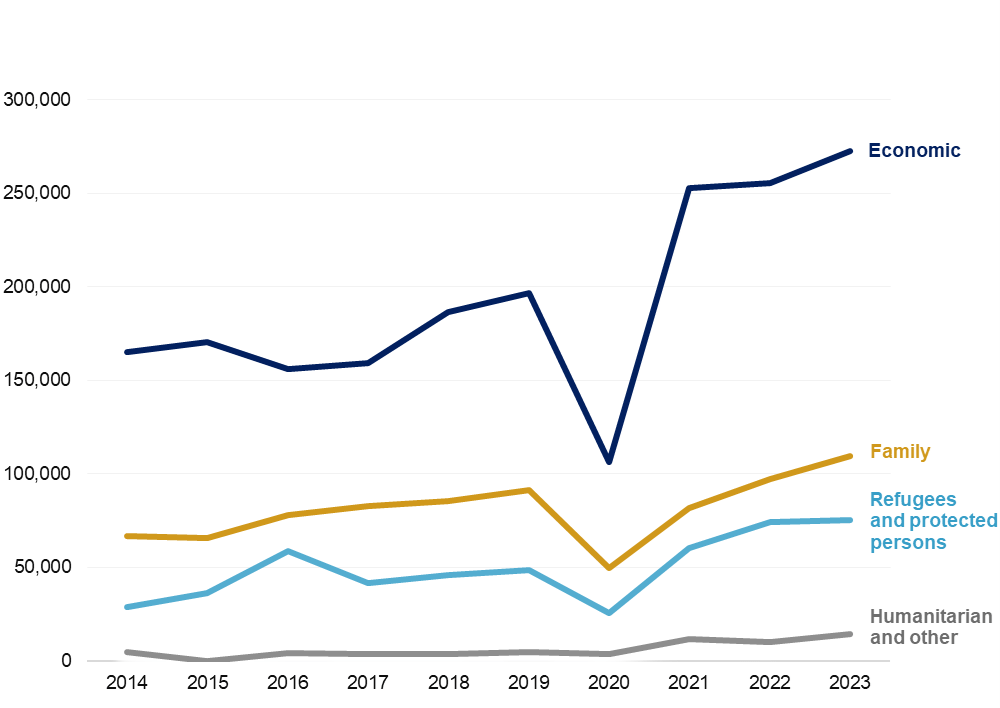
The government is likely to release its 2026–2028 immigration levels plan in fall 2025, when its 2025 Annual Report to Parliament on Immigration is tabled in Parliament. Figure 1 below shows the changes in the number of permanent resident admissions to Canada from 2014 to 2023.
Figure 1 – Number of Permanent Residents Admitted to Canada, by Immigration Category, 2014 to 2023
Source: Figure prepared by the Library of Parliament using data obtained from Immigration, Refugees and Citizenship Canada (IRCC), Facts and Figures 2017: Immigration Overview – Permanent Residents; and IRCC, Annual Report to Parliament on Immigration.
Economic Class
As Figure 1 shows, despite a decline in all immigration streams due to the COVID‑19 pandemic in 2020, more people were selected year after year for their ability to contribute to the Canadian economy.
Although economic immigration levels have risen steadily for more than a decade, the profile of immigrants in this class has also been reviewed to reflect changes made to specific programs. The federal government creates and discontinues pilots and classes within the economic stream depending on many factors, such as the success of a pilot and what becomes of the participants.
Research showing that knowing at least one official language and having work experience in Canada has an impact on successful economic outcomes prompted the federal government to create the Canadian Experience Class in 2008 and to revise the eligibility criteria for the Federal Skilled Worker Program in 2012.
Various factors, including positive outcomes for immigrants nominated by provinces or territories, led to a substantial expansion of these programs. Thus, in 2015, the federal government introduced a new application management system called Express Entry under which the Canadian Experience Class and the Federal Skilled Worker Program are still in effect.
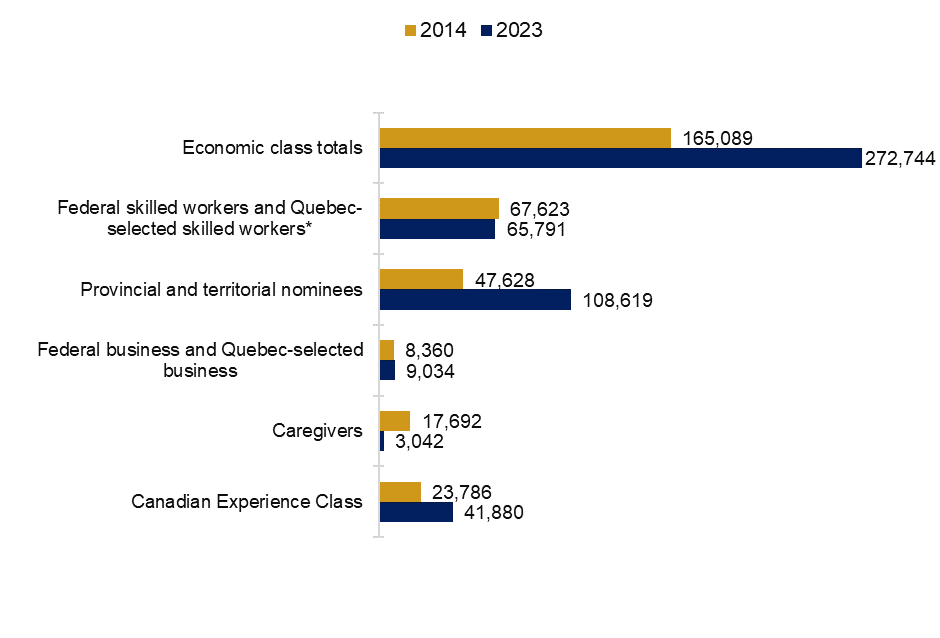
Since its creation 11 years ago, Express Entry has increased the weighted value of key attributes that support the government’s economic priorities, like specific work experience and knowledge of French. A new category-based selection process was also introduced into Express Entry in 2023 to welcome skilled newcomers who have experience in priority jobs, such as healthcare workers and tradespeople, among others. Figure 2 shows the role played by each program in the economic class of immigrants in 2014 and 2023.
Figure 2 – Number of Permanent Residents Admitted to Canada, by Economic Immigration Program, 2014 and 2023
Long description
Comparison of the number of permanent residents admitted to Canada in 2014 and in 2023, by economic immigration sub‑category
| Program | 2014 | 2023 |
| Economic class total | 165,089 | 272,744 |
| Federal skilled workers and Quebec‑selected skilled workers | 67,623 | 65,791 |
| Provincial and territorial nominees | 47,628 | 108,619 |
| Federal business and Quebec‑selected business | 8,360 | 9,034 |
| Caregivers | 17,692 | 3,042 |
| Canadian experience | 23,786 | 41,880 |
Note: Other economic programs created since 2014 are reflected in the Economic Class total for 2023, including the Agri-Food Pilot (1,565 permanent residents admitted in 2023), the Rural and Northern Immigration Pilot (2,855 admitted); the Economic Mobility Pathways Pilot (7 admitted); the Atlantic Immigration Program (3,636 admitted); and the Temporary resident to permanent resident pathway (36,315 admitted).
Source: Figure prepared by the Library of Parliament using data obtained from Immigration, Refugees and Citizenship Canada (IRCC), 2015 Annual Report to Parliament on Immigration; and IRCC, 2024 Annual Report to Parliament on Immigration; and, IRCC, Express Entry Permanent Residents – Monthly IRCC Updates – Canada – Permanent Residents under Express Entry by Province/Territory and Immigration Category, Database, accessed 28 April 2025.
Family Class
Family reunification is a cornerstone of Canada’s immigration policy. It allows Canadian citizens and permanent residents to sponsor spouses, common-law partners and children (considered a priority stream), as well as parents and grandparents. Including accompanying family members admitted under another class, the broader family class of immigration accounts for roughly 60% of all applications for permanent residence.
Recent changes to family reunification policies include priority processing for family members of Canadians and permanent residents affected by the fall of the government in Afghanistan, Russia’s invasion of Ukraine and the conflicts in Gaza and Sudan, as well as changing the temporary resident super visa that parents and grandparents can apply for to visit family in Canada for up to five consecutive years instead of two. A total of 73,113 super visas were issued in 2023. Figure 3 shows the changes in the number of admissions of permanent residents in Canada as part of the family class from 2014 to 2023.
Figure 3 – Number of People Arriving in Canada as Part of the Family Class, by Sub‑category, 2014 to 2023
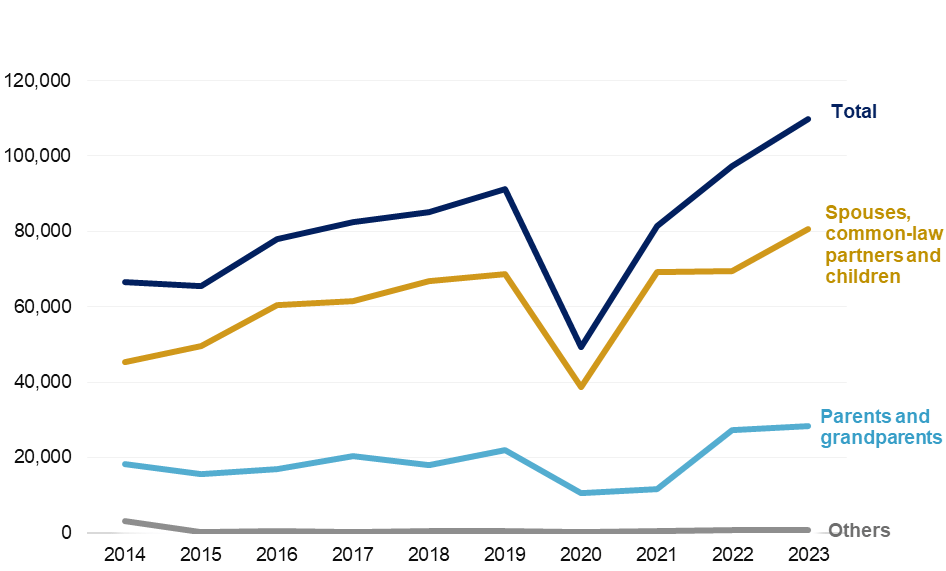
Note: The “Others” category includes orphaned dependant children (orphaned brothers, sisters, nephews, nieces or grandchildren) and other relatives.
Source: Figure prepared by the Library of Parliament using data obtained from Immigration, Refugees and Citizenship Canada (IRCC), Facts and Figures 2017: Immigration Overview – Permanent Residents; and IRCC, Annual report to Parliament on immigration.
Refugee Class
Given Canada’s international commitments to protect and resettle refugees, one objective of its immigration policy is to offer refugee protection to people who have a well-founded fear of persecution and to those whose life or safety is in danger. Some people receive a recommendation for resettlement as refugees in Canada while they are abroad (under the Private Sponsorship of Refugees Program, the Government Assisted Refugee Program or the Blended Visa Office-Referred Program), whereas others make their claim for refugee protection in person at the border or at an inland office within Canada. The decision to grant protection to refugee claimants in Canada is made using the Immigration and Refugee Board of Canada’s refugee determination system.
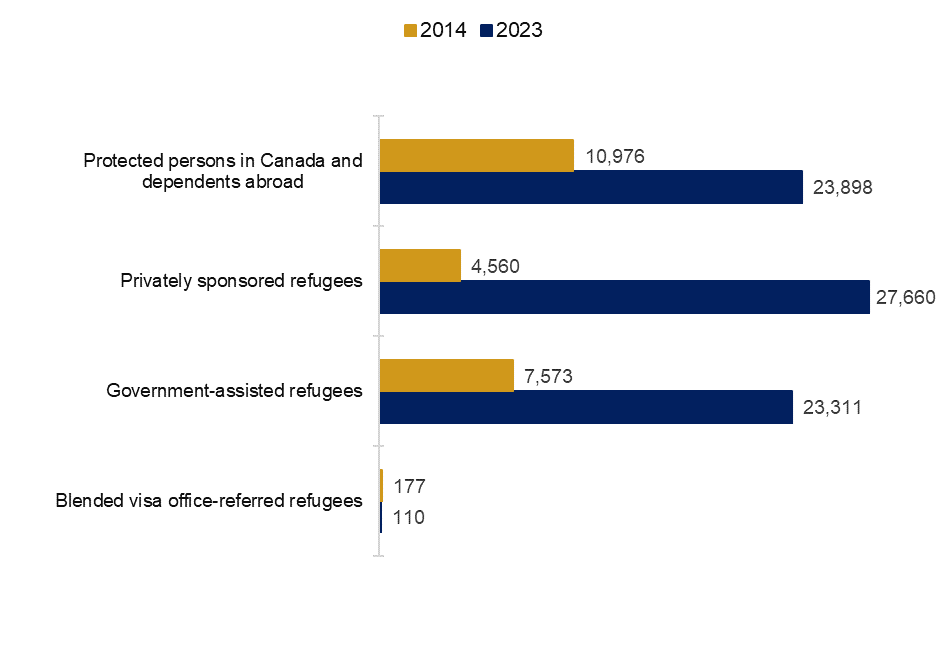
In March 2023, the governments of Canada and the United States (U.S.) announced the expansion of the Safe Third Country Agreement, making it applicable to the entire Canada–U.S. border – not only official ports of entry – to prevent refugee claimants from crossing in between official ports of entry, including at Roxham Road. Four exceptions are possible: family members of people in Canada with status, unaccompanied minors, holders of Canadian admission documents and for the public interest. Figure 4 shows the number of refugees arriving in Canada in 2014 and in 2023 and their distribution by program.
Figure 4 – Number of People Arriving in Canada as Part of the Refugee Class by Sub‑category, in 2014 and in 2023
Source: Figure prepared by the Library of Parliament using data obtained from Immigration, Refugees and Citizenship Canada (IRCC), 2015 Annual Report to Parliament on Immigration; and IRCC, 2024 Annual Report to Parliament on Immigration.
Temporary Residents
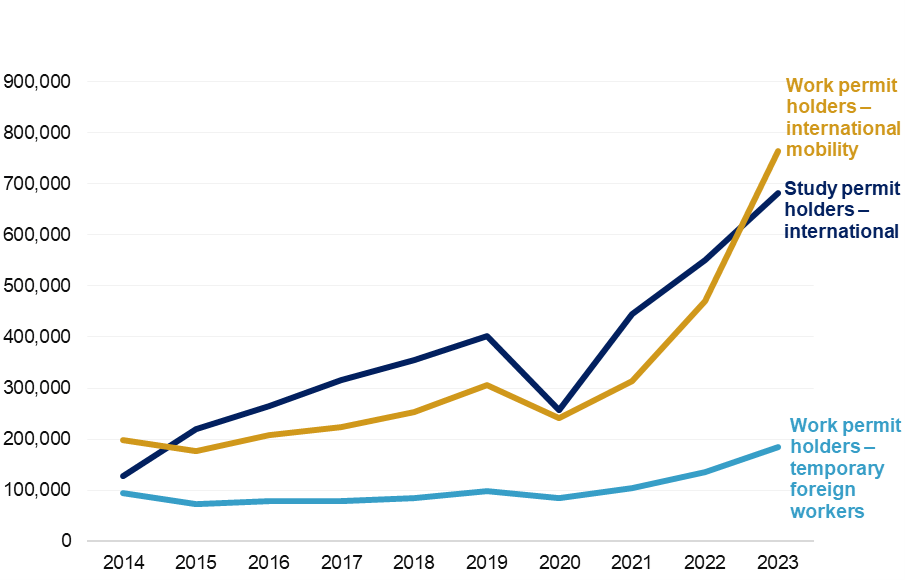
Over the last decade, Canada substantially increased the number of temporary residents it admitted, as shown in Figure 5 below. The temporary resident programs for both international students and various streams of foreign workers have historically been demand-driven, meaning that the government processes applications as they are received, rather than admitting a planned number of temporary residents into the country. However, in January 2024, Immigration, Refugees and Citizenship Canada announced a two-year intake cap on international student permit applications.
Then, among a series of measures announced in March 2024 was the decision to introduce admission targets for all temporary residents from 2025 to 2027. Within this timeframe, the government plans to reduce the proportion of the Canadian population represented by temporary residents from 6.2% to 5%.
The government also announced that programs allowing temporary workers to enter Canada, such as the Temporary Foreign Worker Program, will be reviewed to better align them with labour market needs and mitigate the risk of abuse in the system.
As part of the Temporary Foreign Worker Program, workers are permitted to come to Canada only if the employer can demonstrate that no Canadian, permanent resident or as of May 2024, asylum seeker in Canada with a work permit, is willing and able to do the job.
The International Mobility Program allows employers to hire workers without conducting a labour market impact assessment. It covers workers on reciprocal exchanges, the Working Holiday program, intra-company transfers and other programs that are intended to encourage shared benefits for Canadians and for Canada.
Figure 5 – Number of Temporary Residents Who Hold a Work or Study Permit Admitted into Canada, 2014 to 2023
Source: Figure prepared by the Library of Parliament using data obtained from Immigration, Refugees and Citizenship Canada (IRCC), 2015 Annual Report to Parliament on Immigration; IRCC, 2018 Annual Report to Parliament on Immigration; and IRCC, 2024 Annual Report to Parliament on Immigration.
The clear upward trend in the number of temporary residents is driven by policies that have been in effect for many years. In fact, successive governments have long considered international students and temporary foreign workers to be a growing source of permanent residents using a de facto two-step immigration process in which temporary programs constitute a gateway to permanent residence and in which a person’s studies or work experience in Canada gives them priority standing.
One temporary public policy that contributed to increasing the number of permanent residents in Canada during the COVID-19 pandemic was the temporary resident to permanent resident pathway, which included a French-language stream. Over 106,000 applications were submitted as part of this program. Though this pathway is now closed, some 24,000 permanent residents were admitted in 2021, 39,000 were admitted in 2022 and 36,000 were admitted in 2023.
In 2014, less than 20% of permanent residents previously held a study or work permit. By 2022, that figure had risen to 28.5% and in 2023, it was 38.6%. The 2025–2027 immigration levels plan mentions an “in-Canada focus” and anticipates that in 2025, more than 40% of permanent residents will be former temporary residents.
Related Resources
Béchard, Julie, and Robert Mason. Refugee Protection in Canada. Publication no. 2020‑50‑E. Library of Parliament, 30 July 2020.
Brosseau, Laurence, Camille De La Durantaye-Guillard and Sandra Elgersma. Immigration Policy Primer. Publication no. 2020-05-E. Library of Parliament, 2 November 2023.
Coleman, Lara. Resettling Refugees: Canada’s Humanitarian Commitments. Publication no. 2020-74-E. Library of Parliament, 19 June 2025.
Kachulis, Eleni, and Mayra Perez-Leclerc. Temporary Foreign Workers in Canada. Publication no. 2019-36-E. Library of Parliament, 16 April 2020.
By Andrea Garland, Library of Parliament
Categories: Law, justice and rights, Social affairs and population