

In the words of Ted McWhinney, Member of Parliament, on 21 March 1994, on the occasion of the retirement of Erik John Spicer, the parliamentary librarian at the time, “the Library of Parliament represents a treasure house. It is the jewel in the [C]rown in a real sense in this large parliamentary edifice.”
For 150 years, the Library of Parliament (the Library) has been at the physical and symbolic centre of Canada’s democracy. Its story is not just about a landmark building; it is also about the evolution of a knowledge institution dedicated to the information and research needs of parliamentarians.
Built in the mid-1800s as part of the original Parliament buildings in Ottawa, and opened on 28 February 1876, the Library was always meant to be more than a repository of books. It was built to give lawmakers the reliable information they need to debate laws, pass legislation and hold the government to account. Today, it stands as the Parliament of Canada’s knowledge centre – a modern, non-partisan research library that helps parliamentarians navigate an increasingly complex policy environment.
The building’s own story has been one of resilience and constant care. It has survived two fires and undergone several restorations. If the building itself is a symbol of resilience, so too is the institution it houses. The Library’s services have evolved over the years to meet the changing needs of Parliament.
 Interior view of the Library of Parliament in the 1920s. Canada. Dept. of Interior / Library and Archives Canada / PA-043759.
Milestones in the History of the Library of Parliament
1791–1792: Legislative libraries are established in Upper and Lower Canada.
1841: Following the unification of Upper and Lower Canada, the collections are merged and travel with the Parliament of the new Province of Canada which moves over the years between Kingston, Montréal, Toronto and Québec.
1857: Ottawa becomes the capital and Parliament finds its permanent seat.
1859: Thomas Fuller and Chilion Jones are chosen as the architects of the new Parliament building, including the Library, and construction begins the same year.
1871: The Library of Parliament Act formally establishes the institution.
1876: Construction is completed and the Library opens its doors on 28 February 1876.
1916: A fire destroys the original Centre Block, and the Library is the only part of the building left standing.
1952: A fire breaks out in the dome of the Library, and smoke and water cause heavy damage to both the building and the collection.
1952–1956: The Library undergoes significant restoration and modernization following the fire of 1952.
1965: The Parliamentary Research Branch is established to provide impartial and confidential research and analysis services to parliamentarians.
1996: The Library takes over responsibility for public programs on behalf of the Parliament of Canada, including guided tours and educational products.
2002–2006: A major renovation is undertaken to conserve, rehabilitate and modernize the building. The collection is moved off-site for the duration of the renovation.
2019: The Library closes for the rehabilitation of Centre Block. Its collection is again moved to temporary sites, like the Interim Main Library at 125 Sparks Street.
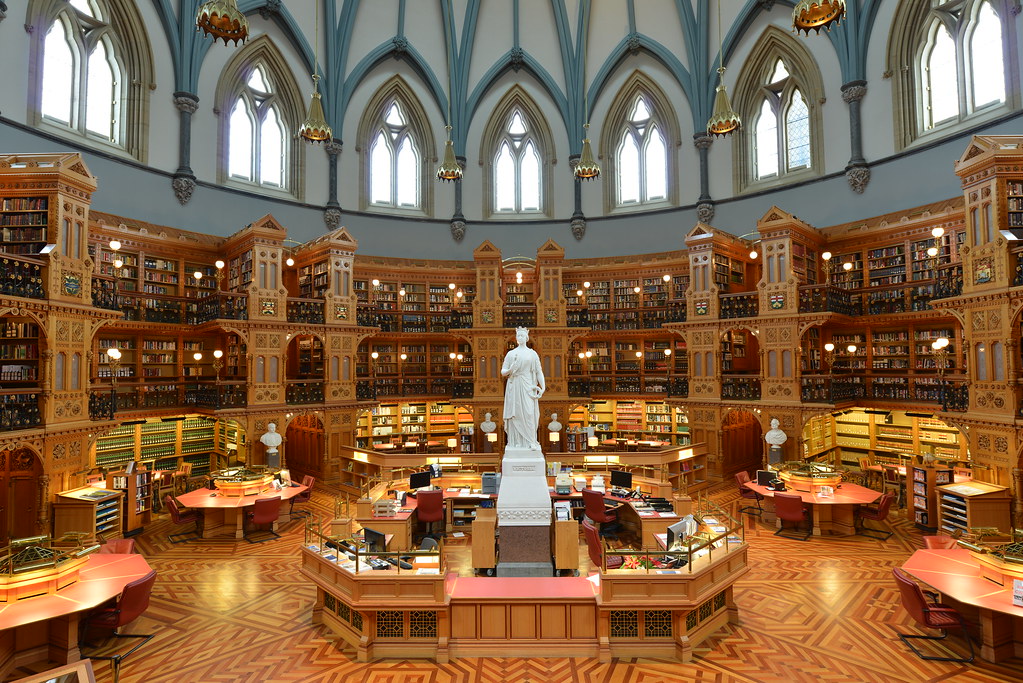 Statue of Queen Victoria in the Library of Parliament. Parliament of Canada.
History
Shortly after Ottawa was chosen as the capital of the Province of Canada, plans began taking shape for the construction of a new Parliament building. In 1859, the Legislative Assembly launched an international design competition in which architects were given just ten weeks to meet detailed requirements. Alpheus Todd, the first parliamentary librarian, added his own conditions, insisting that the new library be housed in a separate structure with fire-proof iron doors. He sought to prevent a fire like the one that destroyed the Parliament buildings in Montréal in 1849 and led to the loss of the library’s collection.
The winning bid by Toronto architects Thomas Fuller and Chilion Jones was selected over 15 other proposals; it featured a neo-Gothic complex, a central tower, symmetrical wings and a round library behind the building, constructed according to Alpheus Todd’s specifications.
The style of the buildings reflected British constitutional traditions and stood in contrast to the neoclassical architecture associated with the United States. Construction began in December 1859 and continued until 1876.
Forty years later, Alpheus Todd’s insightful conditions proved their worth when a fire broke out in Centre Block. In the evening of 3 February 1916, a fire started in the House of Commons reading room and spread rapidly through the largely timber‑framed structure. The bell atop the Peace Tower, then known as the Victoria Tower, tolled the hours until midnight, when the tower collapsed and the bell came crashing down. Although most of Parliament was destroyed, thanks to quick-thinking Library clerk Michael Connolly MacCormac who closed the iron doors, the firefighters who responded swiftly to the alarm and a favourable wind, the Library survived to stand alone amid the ruins.
 Firefighters tackling the blaze during the fire of 1916. Parliament of Canada.
In 1952, only 30 years after Parliament was rebuilt, fire struck again, this time in the very room designed to withstand it, the Library of Parliament, when an electrical fault in the dome sparked a blaze. After 10 hours and nearly 910,000 litres of water, the building was saved, but many books and newspaper collections were damaged in the effort. About 150,000 volumes needed to be removed from the shelves, dried and painstakingly rebound. Smoke and water caused extensive damage to both the building and the collection, and the Library was closed for nearly four years for repairs.
As the Library building was being restored, the institution underwent a transformation of a different kind.To better address the needs of parliamentarians during the post-war expansion of government in the 1950s, the Library hired subject matter specialists and began providing analytical research services to parliamentarians. By the 1960s, a formal parliamentary research structure was established through which the Library offered confidential, non-partisan policy support to senators, members of Parliament and parliamentary committees.
The historic Library building underwent additional conservation work ahead of Canada’s centennial in 1967, stabilizing the structure and restoring its interior.
In 2002, the Library of Parliament building closed again for over five years for major conservation, rehabilitation and modernization. The century-old building was indeed starting to show its age with water damage from poor drainage, worn floors, outdated mechanical systems and insufficient space for its growing collection, staff and new technology. The Thomas Fuller Construction Company, operated by the original Library architect’s great-grandsons, was contracted to manage the multi-year, multi-million-dollar project.
In 2019, the Library of Parliament building closed again due to the ongoing rehabilitation of Centre Block. Although the historic building remains closed until Centre Block re-opens, the Library continues to offer its services through five Library branches located across Parliament Hill, ensuring that parliamentarians have access to trusted expertise, information and knowledge.
Architectural and Decorative Elements
The Library of Parliament is one of Canada’s finest examples of High Victorian Gothic Revival architecture and a remarkable showcase of 19th-century craftsmanship.
Figure 1 – Notable Architectural and Decorative Features

As the Library of Parliament marks its 150th anniversary, the milestone shines a spotlight on the institution’s steadfast and critical role at the heart of the Parliament of Canada. For generations, it has delivered non-partisan research and analysis to parliamentarians, supporting informed debate and evidence-based lawmaking. This anniversary serves as a reminder of the Library’s symbolic strength; as the sole structure to have survived the devastating 1916 fire, it stands as a testament to resilience and continuity, and to the safeguarding of Canada’s parliamentary memory.
By Emilie Lusson, Library of Parliament
Categories: Arts, culture and entertainment, Government, Parliament and politics