
In recent years, global demand for minerals and metals has grown significantly, driven primarily by an energy transition and technological advances. With vast mineral resources and a strong industrial capacity, Canada could position itself to take advantage of the increasing global demand for strategic materials and strengthen its position in global supply chains. To achieve this goal, multiple factors need to be considered, among them the security of the critical minerals supply. Securing critical minerals supply chains entails, among other measures, identifying the parties involved in extracting and processing critical minerals in this country.
Global context
The global demand for certain minerals and metals has increased considerably in recent years, and this upward trend is expected to continue. For example, the International Energy Agency projects that global demand for graphite and nickel could double between 2024 and 2040, based on current policies. This sustained growth is mainly driven by the shift to new energy sources and the need for minerals and metals to produce and store low-emission energy, such as in the manufacture of lithium-ion batteries. Rising demand is also linked to the expanding use of these materials in technologies like semiconductors.
The production and processing of several critical minerals are concentrated in certain regions around the world. The estimated global mine production in 2024 shows that:
- Australia accounts for 37% of the total world lithium production;
- Indonesia accounts for 59% of the total world nickel production;
- the People’s Republic of China (PRC) accounts for 69% of the total world production of rare-earth elements (REEs) and 79% of the total world production of graphite; and
- the Democratic Republic of Congo accounts for 76% of world cobalt mine production.
Canada produces more than 60 minerals and metals. It is the world’s largest producer and exporter of potash, and the second-largest producer and exporter of uranium. While Canada is one of the top 10 global producers of cobalt, graphite, lithium and nickel, it accounts for no more than 5% of the global mine production of each of these minerals and metals.
Once extracted, a mineral must be processed – an umbrella term that refers to the various methods used to treat metals and minerals – before it can be used. The PRC is the world leader in processing or refining several hard-to-process critical minerals; in 2024, its share of global refined material production was 96% for graphite, 91% for REEs, 78% for cobalt, 70% for lithium and 44% for copper. For its part, Canada has ample infrastructure for processing aluminum and uranium.
The concentration of critical mineral production and processing in certain regions around the world leaves Canada and its partners exposed to various risks, such as supply chain disruptions and restrictive measures introduced by certain countries. A mineral is generally considered critical if it:
- has few or no substitutes;
- has strategic importance;
- is available in limited quantities; and
- is extracted and processed in a small number of regions.
Accordingly, many countries, including Canada, have developed a national list of minerals they consider to be critical. This process is intended to guide investments and define priorities to support the associated supply chains. Australia, the United States and the European Union have developed critical mineral lists similar to Canada’s. The Government of Canada also published The Canadian Critical Minerals Strategy in 2022, in which it underscored the need to secure and diversify supply chains.
Securing Critical Minerals Supply Chains
As global demand for critical minerals continues to rise, Canada has an opportunity to leverage its mineral resources and strengthen its position in global supply chains. While foreign direct investment plays a crucial role in supporting this sector, concerns have been raised about foreign ownership of these resources, including during the 2022 study on critical minerals by the House of Commons Standing Committee on Industry and Technology. Such ownership may, among other risks, threaten domestic access to certain minerals and metals. Consequently, it is important to develop a clear and comprehensive understanding of resource ownership within Canada to strengthen the security and resilience of its critical minerals supply chains.
Ownership of Canadian Mining Assets
Because of Canada’s important mineral resources, many companies, both domestic and foreign, are investing in its deposits and its mining infrastructure. As Figure 1 shows, 30 of Canada’s 55 critical mineral mines are owned by companies whose ultimate parent company is based in Canada. In terms of the other mines located in Canada, their ultimate parent companies are based in Brazil, the United States and Switzerland. The PRC is the country of residence of the ultimate parent company of one Canadian mine located in Manitoba which produces multiple critical minerals. The mines producing “other critical minerals” primarily extract multiple critical minerals, potash or helium.
Figure 1 – Active Critical Mineral Mines in Canada, 2025

Sources: Map prepared by the Library of Parliament, 2025, using data obtained from Natural Resources Canada (NRCan), “Canada’s Critical Minerals Map,” Interactive map, accessed 6 May 2025; Statistics Canada, Inter-corporate Ownership, 2024, 16 June 2025; S&P Global, “S&P Capital IQ,” Database, accessed in June 2025; web sites of various corporations; NRCan, Administrative Boundaries in Canada – CanVec Series – Administrative Features, 1:5M, 1 March 2019; NRCan, Lakes, Rivers and Glaciers in Canada – CanVec Series – Hydrographic Features, 1:5M, 1 March 2019. The following software was used: Esri, ArcGIS Pro, version 3.4.2. Contains information licensed under the Open Government Licence – Canada and the Statistics Canada Open Licence.
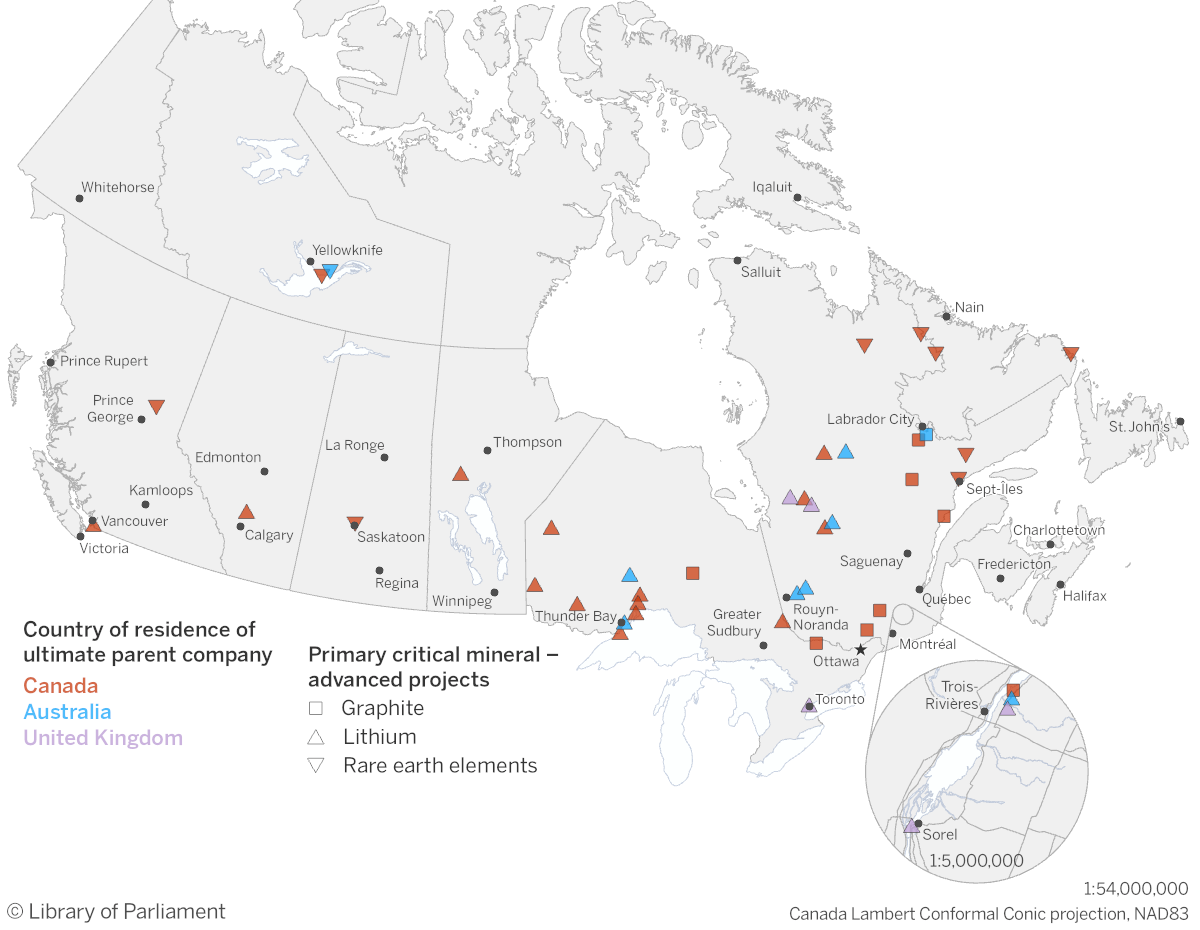
The Government of Canada defines an advanced project as a mining project with confirmed mineral reserves or resources, the viability of which is supported by a preliminary economic assessment or a pre-feasibility study. These projects are associated with sites that extract or plan to extract at least one of Canada’s critical minerals, as well as other minerals and metals. Figure 2 shows that Canada is home to 45 advanced graphite, lithium and REE projects. Thirty-one of those projects are owned by companies whose ultimate parent company resides in Canada.
Figure 2 – Advanced Graphite, Lithium and Rare Earth Elements Projects in Canada, 2025
Sources: Map prepared by the Library of Parliament, 2025, using data obtained from Natural Resources Canada (NRCan), “Canada’s Critical Minerals Map,” Interactive map, accessed 6 May 2025; Statistics Canada, Inter-corporate Ownership, 2024, 16 June 2025; S&P Global, “S&P Capital IQ,” Database, accessed in June 2025; web sites of various corporations; NRCan, Administrative Boundaries in Canada – CanVec Series – Administrative Features, 1:5M, 1 March 2019; NRCan, Lakes, Rivers and Glaciers in Canada – CanVec Series – Hydrographic Features, 1:5M, 1 March 2019. The following software was used: Esri, ArcGIS Pro, version 3.4.2. Contains information licensed under the Open Government Licence – Canada and the Statistics Canada Open Licence.
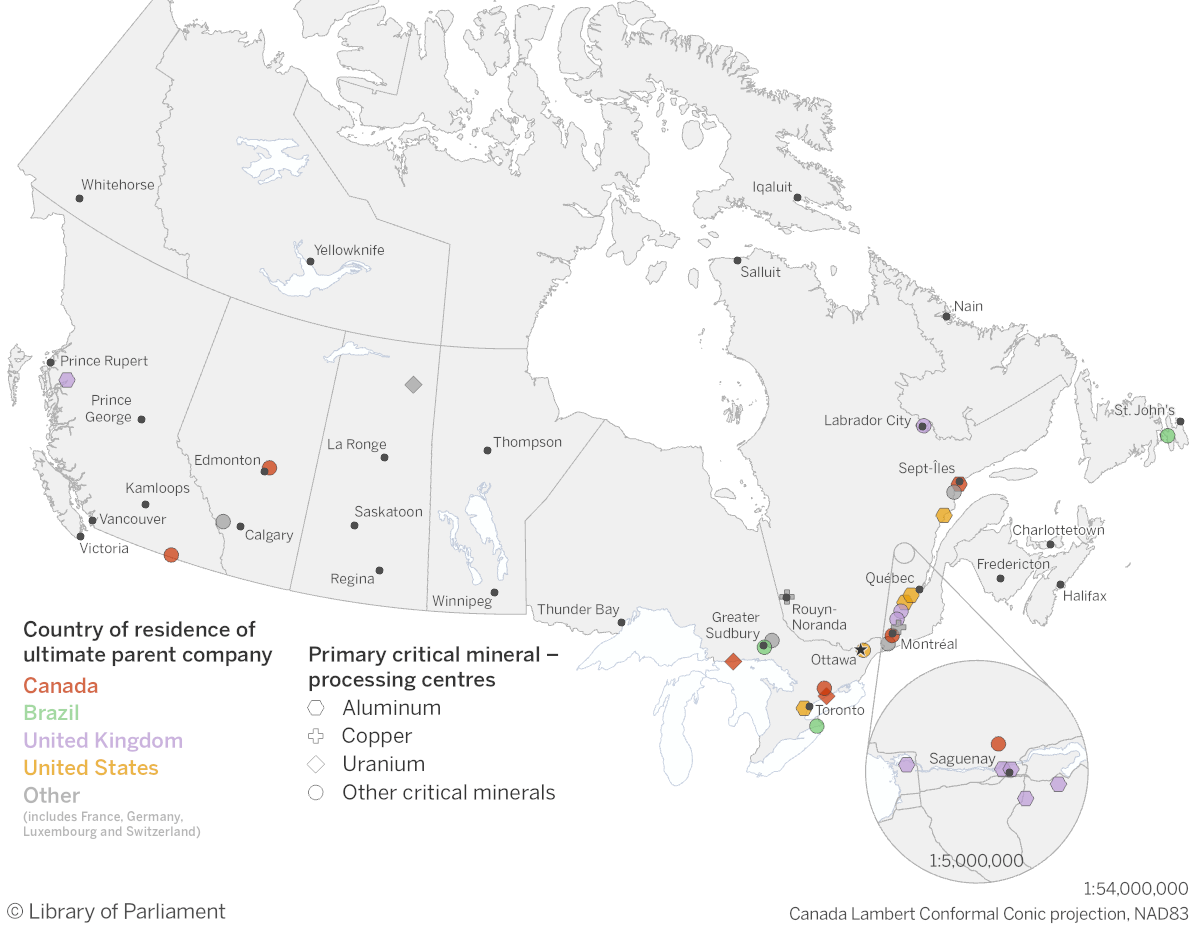
As Figure 3 illustrates, eight of the 32 critical mineral processing centres are owned by companies whose ultimate parent company resides in Canada. The other 24 processing centres are owned by ultimate parent companies that reside in the United Kingdom, the United States, Switzerland, Brazil, France, Germany and Luxembourg, and primarily process aluminum or many other critical minerals.
Figure 3 – Critical Mineral Processing Centres in Canada, 2025
Sources: Map prepared by the Library of Parliament, 2025, using data obtained from Natural Resources Canada (NRCan), “Canada’s Critical Minerals Map,” Interactive map, accessed 6 May 2025; Statistics Canada, Inter-corporate Ownership, 2024, 16 June 2025; S&P Global, “S&P Capital IQ,” Database, accessed in June 2025; web sites of various corporations; NRCan, Administrative Boundaries in Canada – CanVec Series – Administrative Features, 1:5M, 1 March 2019; NRCan, Lakes, Rivers and Glaciers in Canada – CanVec Series – Hydrographic Features, 1:5M, 1 March 2019. The following software was used: Esri, ArcGIS Pro, version 3.4.2. Contains information licensed under the Open Government Licence – Canada and the Statistics Canada Open Licence.
The information in these figures provides a snapshot of the parties involved in the extraction and processing of Canada’s mineral resources. According to the data, Canada is the country of residence of the ultimate parent companies of most mines and processing facilities in Canada. However, to effectively secure supply chains, other factors need to be considered, including the production capacity of the mines and processing centres, Canada’s technical expertise in processing critical minerals like lithium or REEs and the development of transportation infrastructure in rural and remote areas. The data presented do not account for agreements signed with certain companies to reserve part of a mine’s output and provide no indication of the identity or stake of other investors in each mining project. It is also important to note that ownership of mining assets can change considerably over time.
Outlook and Challenges
Although identifying the parties involved in mining and processing Canada’s critical minerals could help secure Canada’s critical mineral supply chains and improve their resilience, several persistent challenges remain.
First, Canada faces various barriers to extracting and processing critical minerals, which include long waiting periods for new mine permits, ongoing struggles to raise capital, particularly for small businesses, and what some stakeholders suggest is a complex regulatory framework.
Second, the mining sector is experiencing labour challenges. According to Canada’s Mining Industry Human Resources Council, the sector faces a tight labour market at a time when it needs new workers. Moreover, certain population groups are underrepresented in the mining sector. For example, while the representation of women has improved in recent years, women accounted for less than 20% of the labour force in the mining sector in 2021. Also, while Indigenous people accounted for 11% of the labour force in the upstream mining sub-sectors in 2021, compared to an average representation of 4% across all industry sectors, Indigenous women continue to encounter barriers to their inclusion in the mining sector.
The Government of Canada has made efforts to address some of the concerns raised above. In the 2024 report on its critical minerals strategy, it stated that it is committed to responding to concerns about the ownership of Canadian mining assets by adapting its foreign investment review regime. Accordingly, it introduced Bill C-34, An Act to amend the Investment Canada Act to strengthen the federal government’s jurisdiction to detect, review and restrict foreign investments that are potentially injurious to Canada’s national security; the bill received Royal Assent on 22 March 2024, and certain provisions came into force on 3 September 2024. Additionally, Bill C‑5, An Act to enact the Free Trade and Labour Mobility in Canada Act and the Building Canada Act which received Royal Assent on 26 June 2025, allows the expedited approval of projects deemed to be of national interest, which could include critical minerals projects.
The Crown has a legal duty to consult Indigenous peoples when it considers actions that may affect their constitutionally protected Indigenous and Treaty rights. A recent Federal Court of Canada decision found that the United Nations Declaration on the Rights of Indigenous Peoples could be used to interpret the scope of the duty to consult. While private parties do not share the duty to consult, it can be triggered when the Crown contemplates the approval of mining projects, and private parties frequently participate in the consultation process.
The Indigenous and Community Relationships Protocol guides relationships between private parties and Indigenous peoples. Decision-making processes in the mining sector have been criticized by some Indigenous nations, and systemic barriers continue to limit Indigenous participation and leadership in the mining industry. Mining activities can also have an adverse impact on these communities, particularly from an intersectional lens or an environmental standpoint.
By Sarah Lemelin-Bellerose
Revised by Isaac Doucette and Sarah Lemelin-Bellerose, Library of Parliament
Categories: Agriculture, environment, fisheries and natural resources, Business, industry and trade