
The size and impact of wildfires in Canada has grown over the past 20 years. This HillNote provides a statistical portrait of wildfires in Canada since 2005, including the personnel mobilized to respond to them and the evacuations they caused. It also summarizes the various jurisdictional responsibilities in terms of wildfires.
Figure 1 illustrates the area burned by wildfire from 2005 to 2024, across Canada.
Figure 1 – Area Burned by Wildfires in Canada, 2005 to 2024
Sources: Map prepared by the Library of Parliament, 2025, using data obtained from Natural Resources Canada (NRCan), Canadian Forest Service, Northern Forestry Centre, Edmonton, Alberta, “National Burned Area Composite (NBAC),” Canadian Wildland Fire Information System (CWFIS) Datamart, Database, accessed on 20 May 2025; NRCan, Administrative Boundaries in Canada – CanVec Series – Administrative Features, 1:5M, 1 March 2019; and NRCan, Lakes, Rivers and Glaciers in Canada – CanVec Series – Hydrographic Features, 1:5M, 1 March 2019. The following software was used: Esri, ArcGIS Pro, version 3.4.2. Contains information licensed under the Open Government Licence – Canada.
Statistical Portrait
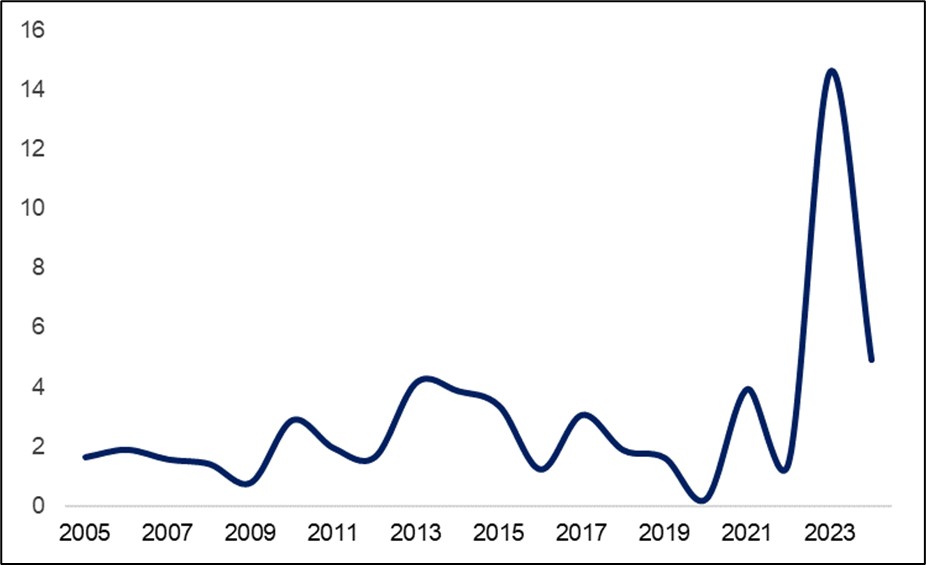
Figure 2 shows that, between 2005 and 2022, the wildfire situation was relatively stable in terms of hectares burned, with an average of 2,129,795 hectares per year. Starting in 2023, however, a large increase can be observed. The years 2023 and 2024 were the most notable in terms of hectares burned since 2005. The area burned in these two years accounts for 33.7% of all hectares burned since 2005, raising the annual average to 2,892,068 hectares burned (a 35.8% increase).
Figure 2 – Area Burned by Wildfires in Canada, 2005 to 2024 (in millions of hectares)
Source: Figure prepared by the Library of Parliament using data obtained from Natural Resources Canada, “Canadian National Fire Database (CNFDB),” accessed 20 May 2025.
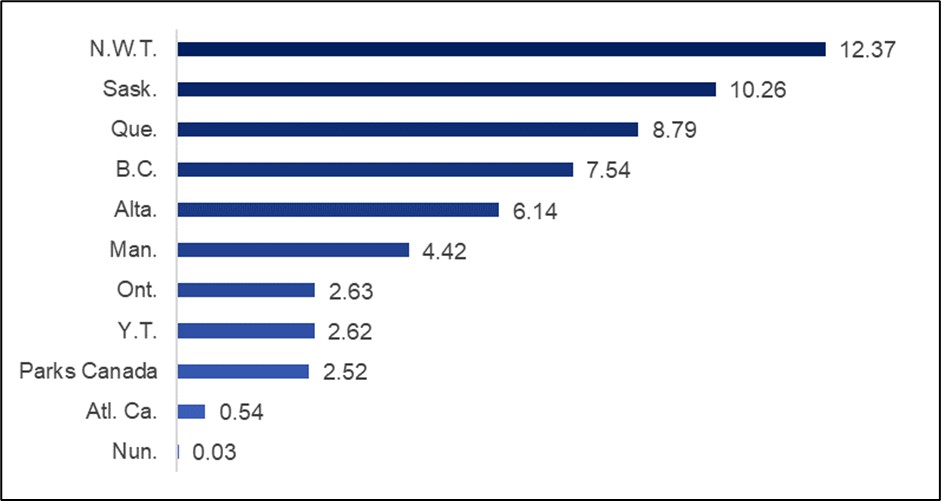
Figure 3 shows the breakdown of hectares burned by wildfires in Canada between 2005 and 2024. Two provinces and one territory share a combined 54.32% of the total number of hectares burned: Northwest Territories (21.38%), Saskatchewan (17.75%) and Quebec (15.19%).
Figure 3 – Distribution of the Total Number of Hectares Burned, by Province, Territory, Region and Parks Canada, 2005 to 2024 (in millions of hectares)
Source: Figure prepared by the Library of Parliament using data obtained from Natural Resources Canada, “Canadian National Fire Database (CNFDB),” accessed 20 May 2025.
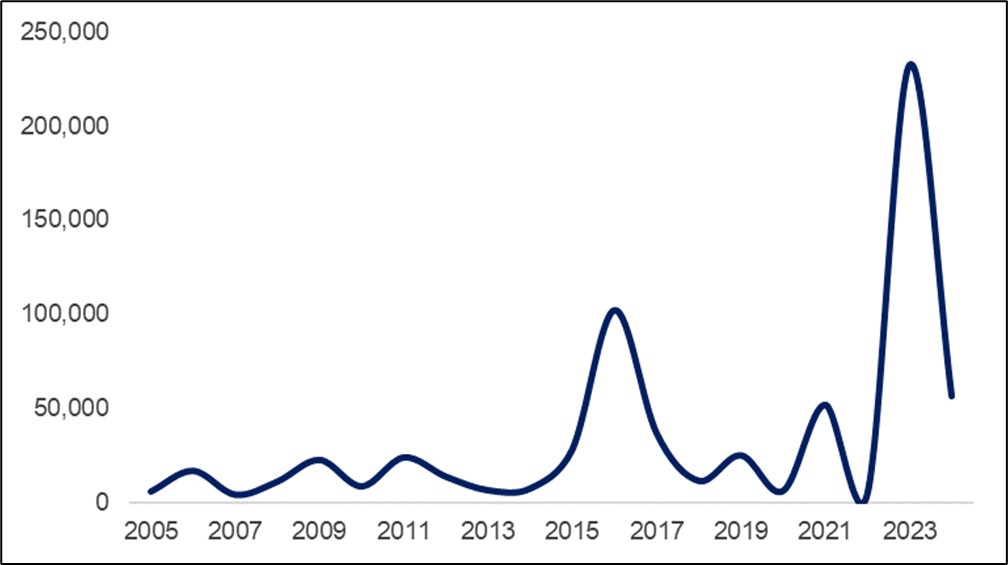
On average, 33,631 people are evacuated every year due to wildfires. Figure 4 shows that two years stand out from the rest: 2016, mainly because of the Fort McMurray wildfire, and 2023, due to a record wildfire season. The number of people evacuated because of wildfires has also been on the rise. Between 2005 and 2014, an average of 11,896 people were evacuated each year; from 2015 to 2024, that number rose to a total of 55,366 people evacuated each year.
Figure 4 – Number of Wildfire Evacuees in Canada, 2005 to 2024
Source: Figure prepared by the Library of Parliament using data obtained from Natural Resources Canada, “Canadian National Fire Database (CNFDB),” accessed 20 May 2025.
First Nations communities are among the populations most affected by wildfires. Nearly 80% of First Nations communities living on reserves are considered at risk of being affected by wildfires due to factors like their remote location and limited access to services during emergencies. On average across Canada, these communities face 52 wildfire emergencies every year. In 2023, a total of 161 wildfires threatened their safety and 90 communities were evacuated.
First Nations people living on reserves are also more frequently affected by evacuations than the rest of Canada: between 2014 and 2024, a total of 97,496 First Nations people living on reserves were evacuated due to wildfires. In total, 560,938 people from the entire Canadian population were evacuated during this period, meaning that 17.38% of all evacuees were from First Nations communities living on reserves. Notably, according to the 2021 Census, First Nations people living on reserves represent only 1.98% of the Canadian population. Figure 5 shows that the number of First Nations people living on reserves who were evacuated due to wildfires was highest in Saskatchewan, Alberta and Manitoba.
Figure 5 – Number of First Nations People Living On Reserves and in Other Eligible First Nations Communities Evacuated due to Wildfires, by Province, Territory and Region, 2014 to 2024

Note: The numbers in Figure 5 regarding the Northwest Territories are preliminary rather than final.
Source: Figure prepared by the Library of Parliament using data obtained from Government of Canada, Wildland fire and flood evacuation statistics between April 1, 2014 and March 31, 2024.
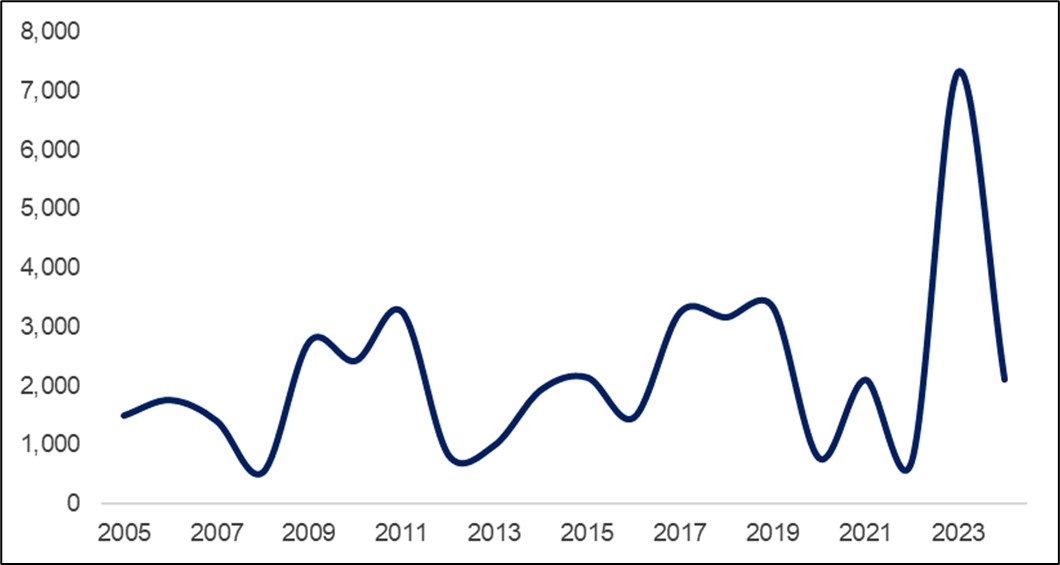
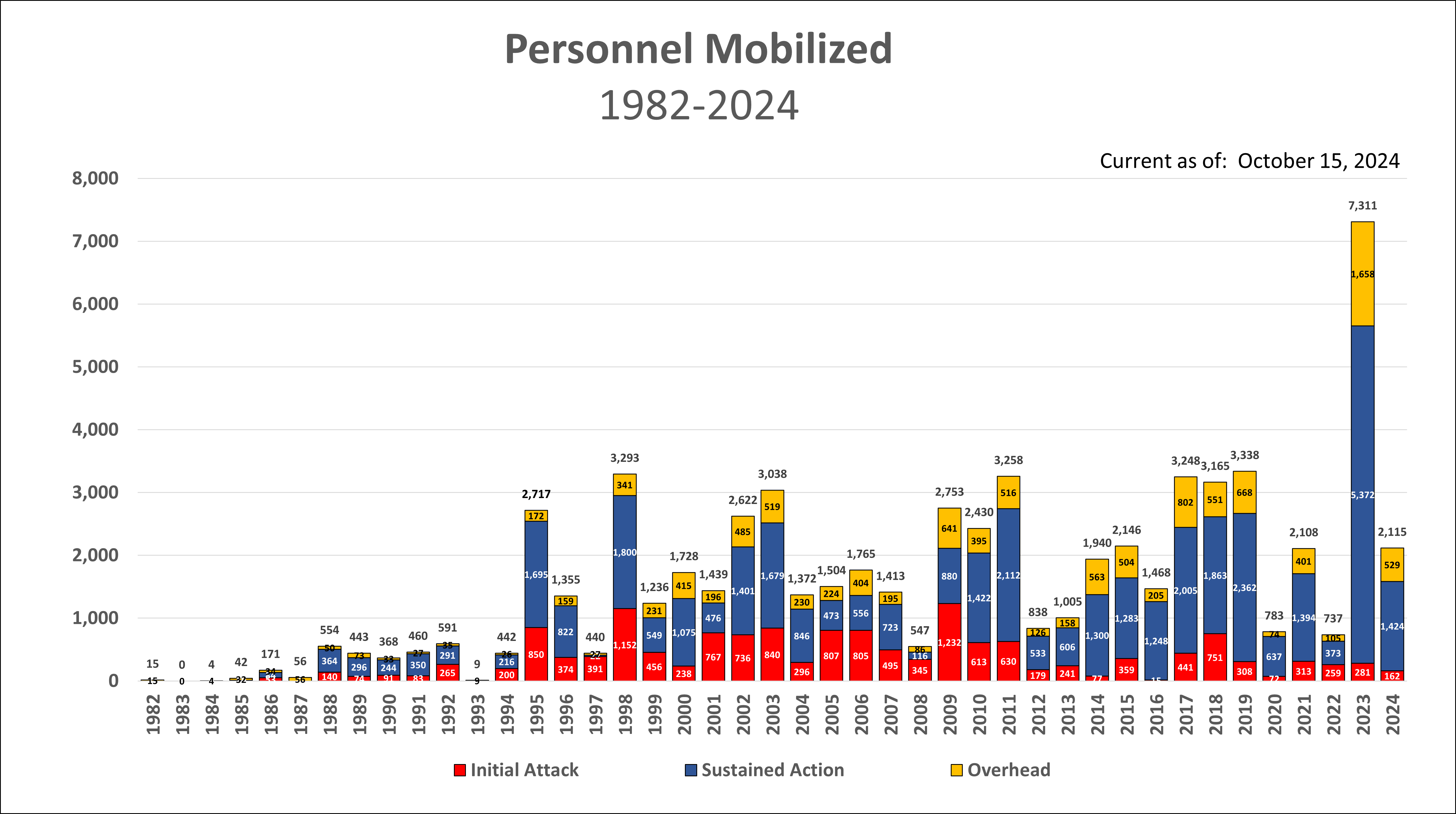
Figure 6 shows the changes in the number of personnel mobilized to fight wildfires from 2005 to 2024. A total of 43,872 people were mobilized during that period. The average number of personnel mobilized annually between 2005 and 2014 was 1,745; this number rose to an average of 2,642 personnel mobilized each year between 2015 and 2024 – an increase of 51.37%.
Figure 6 – Number of Personnel Mobilized to Respond to Wildfires in Canada, 2005 to 2024
Source: Figure prepared by the Library of Parliament using data obtained from Canadian Interagency Forest Fire Centre, Personnel Mobilized 1982–2024.
Jurisdictional Responsibilities
Section 92 of the Constitution Act, 1867 sets out the provincial legislatures’ exclusive powers. Among others, section 92A grants provincial legislatures the exclusive authority to make laws in relation to the development, conservation and management of non-renewable natural resources and forestry resources in the province. The division of powers is complex because of the overlapping provincial and federal jurisdictions under the Constitution Act, 1867.
Furthermore, the Constitution Act, 1867 states that the federal government also has exclusive legislative authority for “Indians and lands reserved for the Indians.” Accordingly, the federal government provides programs and services to First Nations people living on reserves, in particular, with respect to emergency management.
Provincial or territorial agencies are responsible for wildfire management in most of Canada’s forests. Areas where federal government agencies are responsible include national parks and military bases.
The federal Emergency Management Act states that the Minister of Public Safety and Emergency Preparedness is responsible for “exercising leadership relating to emergency management in Canada by coordinating, among government institutions and in cooperation with the provinces and other entities, emergency management activities.”
In Canada, emergencies are managed first at the local level and then at the provincial or territorial level. As such, emergency management is shared between federal, provincial or territorial and Indigenous governments and their partners.
Federal Level
During a major wildfire event, provinces and territories can submit requests for federal assistance to the Minister of Public Safety. In 2024, the Minister approved five such requests for wildfire support: three from Alberta, one from Manitoba and one from Newfoundland and Labrador. These requests prompted Public Safety Canada’s Government Operations Centre to coordinate responses with other departments for a whole-of-government approach.
For instance, in July 2024, when wildfires spread from Jasper National Park in Alberta to the Municipality of Jasper, the Canadian Armed Forces provided firefighting resources and evacuation support. Other federal departments and partners – Parks Canada, the Canadian Interagency Forest Fire Centre (CIFFC), Public Service and Procurement Canada, the Canadian Coast Guard and Employment and Social Development Canada – were prepared to assist the province of Alberta as part of their own respective mandates.
Public Safety Canada played a key role, through the Humanitarian Workforce Program, in its work with non-governmental organizations like the Canadian Red Cross, the Salvation Army, St. John Ambulance, and the Search and Rescue Volunteer Association of Canada during the 2024 wildfires in Alberta and in Newfoundland and Labrador.
Collaboration Between Provincial, Territorial and Federal Governments
Direct wildfire response is under provincial or territorial jurisdiction. Provincial or territorial agencies, such as Alberta Wildfire, BC Wildfire Service and the Société de protection contre les feux de forêt, are responsible for suppressing wildfires, managing risks and collaborating with the CIFFC.
The CIFFC is a not-for-profit corporation owned and operated by the provincial, territorial and federal governments. Its mandate is to support its members, including provincial and territorial agencies, Parks Canada and Natural Resources Canada, in the management, prevention and mitigation of wildfires, and in their response on the ground.
Parks Canada imports and exports resources, personnel and equipment from or to other Canadian fire management agencies. It is the only federal organization that manages and responds to wildfires on the ground in national parks. Natural Resources Canada works closely with the provinces and territories to provide technical support for mapping wildfire hotspots and modelling fire behaviour predictions.
The CIFFC coordinates the sharing of resources (personnel, equipment and aircraft) among the provinces and territories, and with international partners. In its annual reports, the CIFFC also provides data on wildfire mobilizations, which includes the exceptional numbers for the 2023 wildfire season: 7,311 international and domestic personnel and the use of 17,150 lengths of hose, 809 pumps and 46 aircraft.
Local Level
In a 2024 report of the Canadian Association of Fire Chiefs, over 90% of Canadian fire departments responded to wildfires in 2023, but only half were wildfire-ready with the required equipment. Furthermore, only 18% of local fire departments received funding or equipment from their province or territory for wildfire support in 2023.
Some testimony before the House of Commons Standing Committee on Indigenous and Northern Affairs suggests that First Nations fire services face funding challenges which affects their ability to purchase equipment and train and hire firefighters.
As wildfires increasingly affect the edges of urban and more populated areas, local jurisdictions can seek additional assistance from their respective province or territory.
First Nations Communities Living On Reserves and Wildfires
When a wildfire emergency involves a First Nation community living on reserves, the community’s leadership uses all available resources to respond. If the emergency exceeds the community’s response capacity, it notifies Indigenous Services Canada (ISC) and the appropriate provincial and territorial officials. ISC has service agreements with some provinces and territories and with other organizations that provide emergency response services to First Nations communities living on reserves.
In testimony before the Standing Senate Committee on Agriculture and Forestry in 2024, representatives of some First Nations communities living on reserves indicated that they are excluded from the response coordination and decision-making activities in wildfire emergencies.
Further Reading
Brideau, Isabelle et al. The Distribution of Legislative Powers: An Overview. Publication No. 2019‑35‑E. Library of Parliament, 16 October 2019.
Fryer, Sara and Olivier Leblanc-Laurendeau, Understanding Federal Jurisdiction and First Nations. Publication No. 2019-51-E. Library of Parliament, 29 November 2019.
By Nicolas Berniquez-Villemaire and Joanne Markle LaMontagne, Library of Parliament
Categories: Agriculture, environment, fisheries and natural resources, Health and safety