
The Canada–European Union (EU) Comprehensive Economic and Trade Agreement (CETA) was signed in October 2016. Since then, the Canadian and European parliaments have adopted the agreement, and 17 of the EU’s 27 member states have ratified it.
This HillNote discusses the steps that Canada, EU institutions and individual EU member states have taken as of 31 August 2025 concerning CETA’s application and ratification. As part of that discussion, information about Canada’s merchandise trade, services trade and foreign direct investment with each EU member state is provided. The HillNote also examines the debate about the potential effects on CETA’s implementation if an EU member state were to fail to ratify the agreement.
Provisional Application
The EU considers CETA to be a mixed agreement because it covers areas in which the EU has exclusive competence and areas in which the EU shares competence with EU member states.
The Council of the European Union (Council of the EU), comprising ministers from each EU member state, may decide to apply a mixed trade agreement provisionally. In October 2016, the Council of the EU adopted decisions enabling CETA’s provisional application, pending the European Parliament’s approval of the agreement. The European Parliament approved CETA in February 2017, and the agreement has been provisionally applied since September 2017.
As a mixed agreement, CETA will be fully in force when all EU member states provide the Council of the EU with their notification of ratification.
Most of CETA’s provisions are within the EU’s exclusive competence, and an estimated 90% of the agreement is currently in force. For instance, market access provisions that eliminate duties on at least 98% of the products traded between Canada and the EU are in effect, as are most provisions relating to services.
As well, CETA’s governance structure is fully operational. Bodies established under the agreement meet regularly and have made recommendations on various issues, such as trade and gender, climate change, and small and medium-sized businesses.
However, certain provisions in CETA’s investment, financial services and intellectual property chapters are not being provisionally applied. These provisions include an investment protection framework and the establishment of a court system to settle investor–state disputes.
Ratification Status
Regarding CETA’s provisional application, Canada used its usual process for ratifying treaties. Parliament approved the agreement by adopting the Canada–European Union Comprehensive Economic and Trade Agreement Implementation Act, which received Royal Assent in May 2017.
The terms of CETA’s provisional application in Canada were then established by an order in council. Canada can fully ratify the agreement through another order in council once all EU member states have ratified CETA.
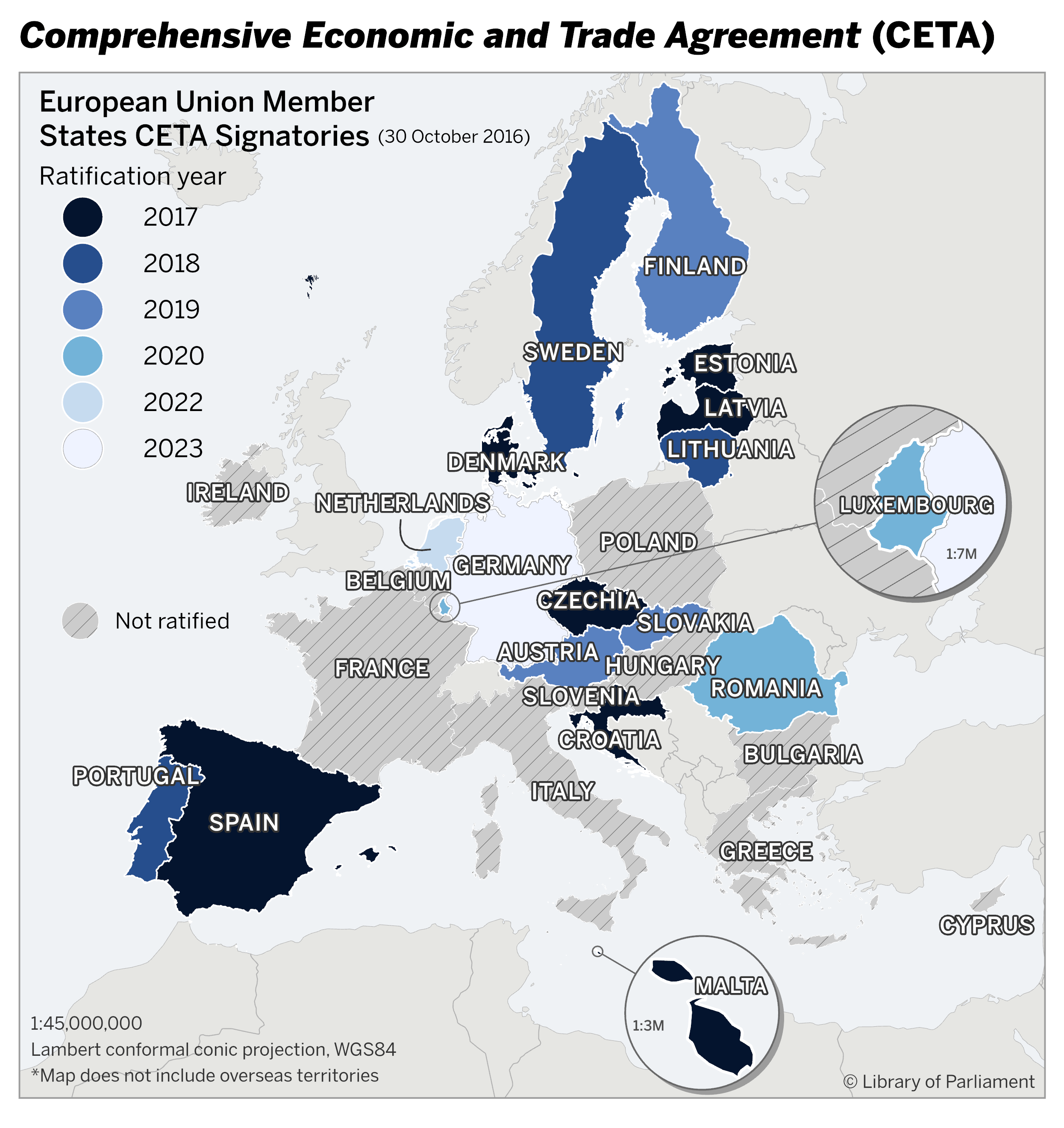
Figure 1 shows that, as of 31 August 2025, 17 EU member states had completed their respective internal ratification processes.
Figure 1 – European Union Member States’ Ratification of the Canada–European Union Comprehensive Economic and Trade Agreement, by year, as of 31 August 2025
Long description
Table showing the 17 member states of the European Union that have ratified the Comprehensive Economic and Trade Agreement, by year of ratification:
| Year of Ratification | Member State |
| 2017 | Croatia, Czechia, Denmark, Estonia, Latvia Malta, Spain |
| 2018 | Lithuania, Portugal, Sweden |
| 2019 | Austria, Finland, Slovakia |
| 2020 | Luxembourg, Romania |
| 2022 | The Netherlands |
| 2023 | Germany |
The 10 member states of the European Union that have not yet ratified the agreement are the following: Belgium, Bulgaria, Cyprus, France, Greece, Hungary, Ireland, Italy, Poland and Slovenia.
Sources: Map prepared by the Library of Parliament, 2024, using data obtained from Natural Earth, 1.50m Cultural Vectors, version 5.1.1; and European Council and Council of the European Union, “Comprehensive Economic and Trade Agreement (CETA) between Canada, of the one part, and the European Union and its Member States, of the other part,” accessed 18 June 2024. The following software was used: Esri, ArcGIS Pro, version 3.3.1.
Some EU member states with which Canada has the highest-valued merchandise trade and services trade – including France, Ireland and Italy – have not yet ratified CETA. In 2024, Italy and France were Canada’s second- and third-largest merchandise trade partners in the EU, respectively. France and Ireland were Canada’s primary and third-largest services trade partners in the EU, respectively, in 2023.
Figure 2 shows the value of Canada’s merchandise trade and services trade with individual EU member states in 2023. It also presents the member states that had ratified CETA as of 31 August 2025 and those that had not.
Figure 2 – Merchandise Trade and Services Trade between Canada and European Union Member States, 2023 ($ billions), and Ratification Status of the Canada–European Union Comprehensive Economic and Trade Agreement, by Member State, as of 31 August 2025

Notes: The merchandise trade data are customs-based; the services trade data are balance of payments–based. Services trade data do not include Belgium, Bulgaria, Croatia, Cyprus, Czechia, Hungary, Latvia, Lithuania, Luxembourg, Malta, Romania, Slovakia or Slovenia. Data for Canada’s services trade with these countries are not available for 2023.
Sources: Figure prepared by the Library of Parliament using data obtained from Government of Canada, “Trade Data Online,” Database, accessed 29 April 2025; Statistics Canada, “Table 36-10-0007-01: International transactions in services, by selected countries, annual (x 1,000,000),” Database, accessed 29 April 2025; and European Council and Council of the European Union, Comprehensive Economic and Trade Agreement (CETA) between Canada, of the one part, and the European Union and its Member States, of the other part, accessed 31 August 2025.
The three EU member states with which Canada has the top bilateral investment relationships – the Netherlands, Luxembourg and Germany – have completed their respective ratification processes for CETA.
Figure 3 shows, for 2023, the stock of Canada’s foreign direct investment in each EU member state and the stock of each member state’s investment in Canada. It also indicates, as of 31 August 2025, the member states that had ratified CETA and those that had not. All EU member states must ratify the agreement for its investment-related provisions to enter into force
Figure 3 – Canada and European Union Member States’ Stock of Foreign Direct Investment, 2023 ($ billions), and Ratification Status of the Canada–European Union Comprehensive Economic and Trade Agreement, by Member State, as of 31 August 2025

Sources: Figure prepared by the Library of Parliament using data obtained from Statistics Canada, “Table 36-10-0008-01: International investment position, Canadian direct investment abroad and foreign direct investment in Canada, by country, annual (x 1,000,000),” Database, accessed 11 March 2025; and European Council and Council of the European Union, Comprehensive Economic and Trade Agreement (CETA) between Canada, of the one part, and the European Union and its Member States, of the other part, accessed 31 August 2025.
Recent Refusals to Ratify
In 2019, France’s National Assembly approved a bill that included the authorization to ratify CETA. France’s Senate must also approve the bill for France to ratify the agreement. In March 2024, the Senate amended the bill [in French], thereby refusing CETA’s ratification. This outcome led to renewed debate about the agreement’s implementation if an EU member state were not to ratify CETA. As of 31 August 2025, the amended bill had not returned to the National Assembly for consideration.
In July 2020, Cyprus’s unicameral parliament voted against the ratification of CETA.
For the other eight EU member states that have not ratified CETA, some legislatures have not yet started to consider the agreement’s ratification; others have started their consideration, but a ratification vote has not been held.
Debate About the Potential Effects of a Failure to Ratify
In a statement accompanying its 2016 decisions relating to CETA, the Council of the EU indicated that the agreement’s provisional application would be terminated if an EU member state were to provide “formal notification” of its “permanent and definitive” failure to ratify CETA. Regarding Cyprus, because the country did not provide such formal notification, CETA’s provisional application was not affected.
Commentator’s have debated whether an EU member state’s failure to ratify CETA would require the EU to terminate the agreement’s provisional application.
For instance, a 2020 article published in The European Journal of International Law highlights statements that some EU member states made in 2016 asserting their right to terminate CETA’s provisional application. However, the article also stresses that most experts agree that an EU member state cannot unilaterally terminate the agreement’s provisional application; instead, such an action would require the involvement of EU institutions.
The Council of the EU’s 2016 statement clarifies that termination of CETA’s provisional application would be done “in accordance with EU procedures.” An analysis of CETA’s implementation by the European Parliamentary Research Service suggests that these procedures include a requirement that a qualified majority of the Council of the EU – that is, 15 EU member states representing 65% of the EU’s population – adopt a decision to terminate the agreement.
Finally, in an analysis published following the vote on CETA in the French Senate, two University of Ottawa academics asserted that the Council of the EU could decide that the provisional application should become permanent or that the agreement should be renegotiated.
Ratification Delays and Canada
According to Canadian experts Mark Camilleri, President of the Canada EU Trade and Investment Association, and Steve Verheul, Canada’s former Chief Trade Negotiator, EU member states’ failure to ratify CETA or further delays in the agreement’s ratification by all EU member states could negatively affect Canada. They note that these delays both create uncertainty for Canadian businesses that “rely on cross-border investment and trade in goods and services” and influence foreign direct investment decisions in Canada and the EU.
CETA’s ratification by all 27 EU member states is experiencing challenges. While CETA already governs the majority of trade between Canada and the EU, whether all of its provisions come into force as intended when CETA was signed almost a decade ago will depend on the actions that EU member states and institutions take.
Additional Resources
Brown, Colin, and Sylvie Tabet. “Trans-Atlantic Trade: The Comprehensive Economic and Trade Agreement between Canada and the European Union and its Member States.” In Daniel Bethlehem, et al., eds., The Oxford Handbook of International Trade Law. 2nd edition, 2022.
European Parliament. An analysis of the implementation of the EU-Canada Comprehensive Economic and Trade Agreement (CETA), November 2023.
Puccio, Laura. A guide to EU procedures for the conclusion of international trade agreements. Briefing. European Parliamentary Research Service, 2 October 2016.
Suse, Andrei, and Jan Wouters. “The Provisional Application of the EU’s Mixed Trade and Investment Agreements.” Leuven Centre for Global Governance Studies and the Institute for International Law. Working Paper No. 201, May 2018.
Van der Loo, Guillaume, and Ramses A. Wessel. “The Non-Ratification of Mixed Agreements: Legal Consequences and Solutions.” Common Market Law. Vol. 54, No. 3, May 2017.
By Anne-Marie Therrien-Tremblay, Library of Parliament
Categories: Business, industry and trade, International affairs and defence