
The Government of Canada offers some services directly to Canadians, such as the screening services provided by the Canadian Air Transport Security Authority, or the provision of passports (for a fee). However, for the most part, it transfers funds to other orders of government, individuals or third parties. This HillNote outlines the arrangements and procedures governing the federal government’s system of transfer payments, particularly as it pertains to voted programs.
Overview
The federal government does not acquire any goods, services or assets through transfer payments. Instead, it uses transfer payments as a means of achieving its policy objectives. For example, the transfer may offer income supports to individuals or provide funds to a third party to deliver services, such as labour training programs. Transfer payments can be either statutory or voted. Statutory transfer payments are authorized by permanent legislation passed by Parliament (e.g., the Old Age Security Act or the Employment Insurance Act). Voted transfer payments, on the other hand, take the form of grants and contributions. (This can include another category referred to as “other transfer payments,” which are used for various programs.) They must be authorized annually by Parliament through the estimates and appropriation acts and typically exist to meet specific policy goals.
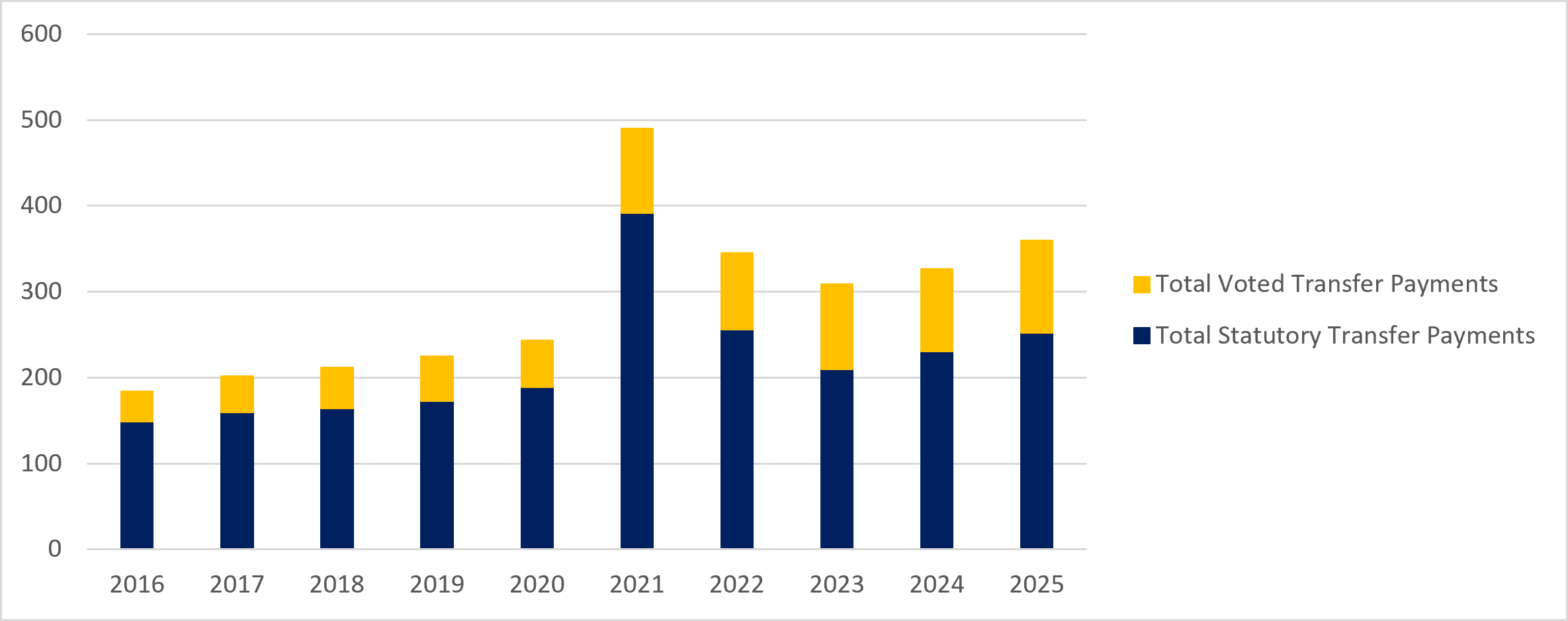
In 2024–2025, the Government of Canada spent $359 billion on transfer payments, which represented around 73% of total program expenses. This amount represented a near doubling of transfer payment expenditures compared to the 2015–2016 fiscal year. Figure 1 presents total federal transfer payments (i.e., statutory and voted transfers) over the past 10 years.
Figure 1: Federal Transfer Payments (Statutory and Voted), 2016–2025 ($ billions)
 Note: The fiscal year runs from 1 April through 31 March of the following year.
Source: Figure prepared by the Library of Parliament based on data obtained from Government of Canada, Public Accounts of Canada.
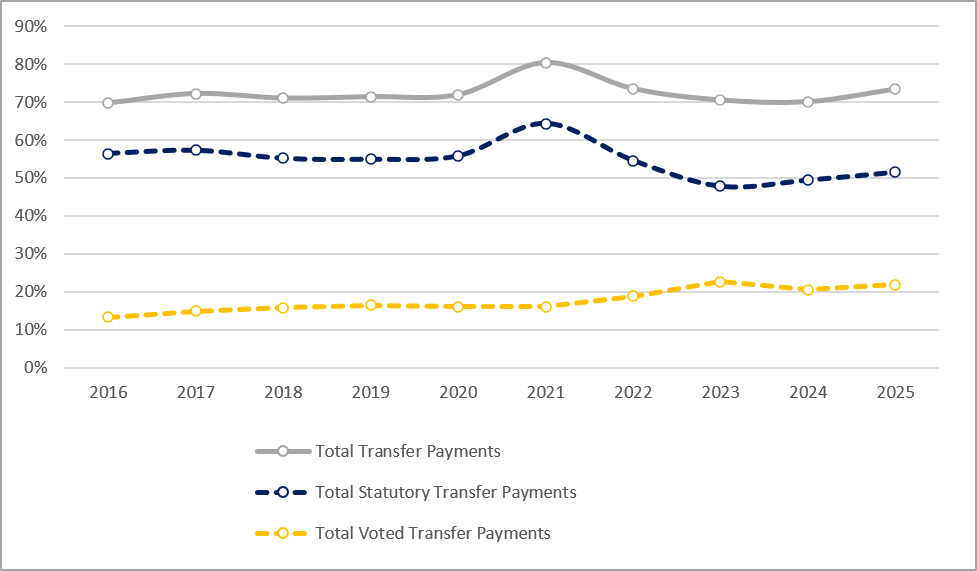
Figure 2 shows the trend in transfer payments as a percentage of total program expenses over the past 10 years. Although the percentage of total transfers as a share of program expenses has remained mostly constant (except during the COVID-19 pandemic), the share of statutory versus voted transfers has changed somewhat.
Figure 2 – Transfer Payments as a Share of Total Program Expenses, 2016–2025
Note: The fiscal year runs from 1 April through 31 March of the following year.
Source: Figure prepared by the Library of Parliament based on data obtained from Government of Canada, Public Accounts of Canada.
Statutory Transfer Payments
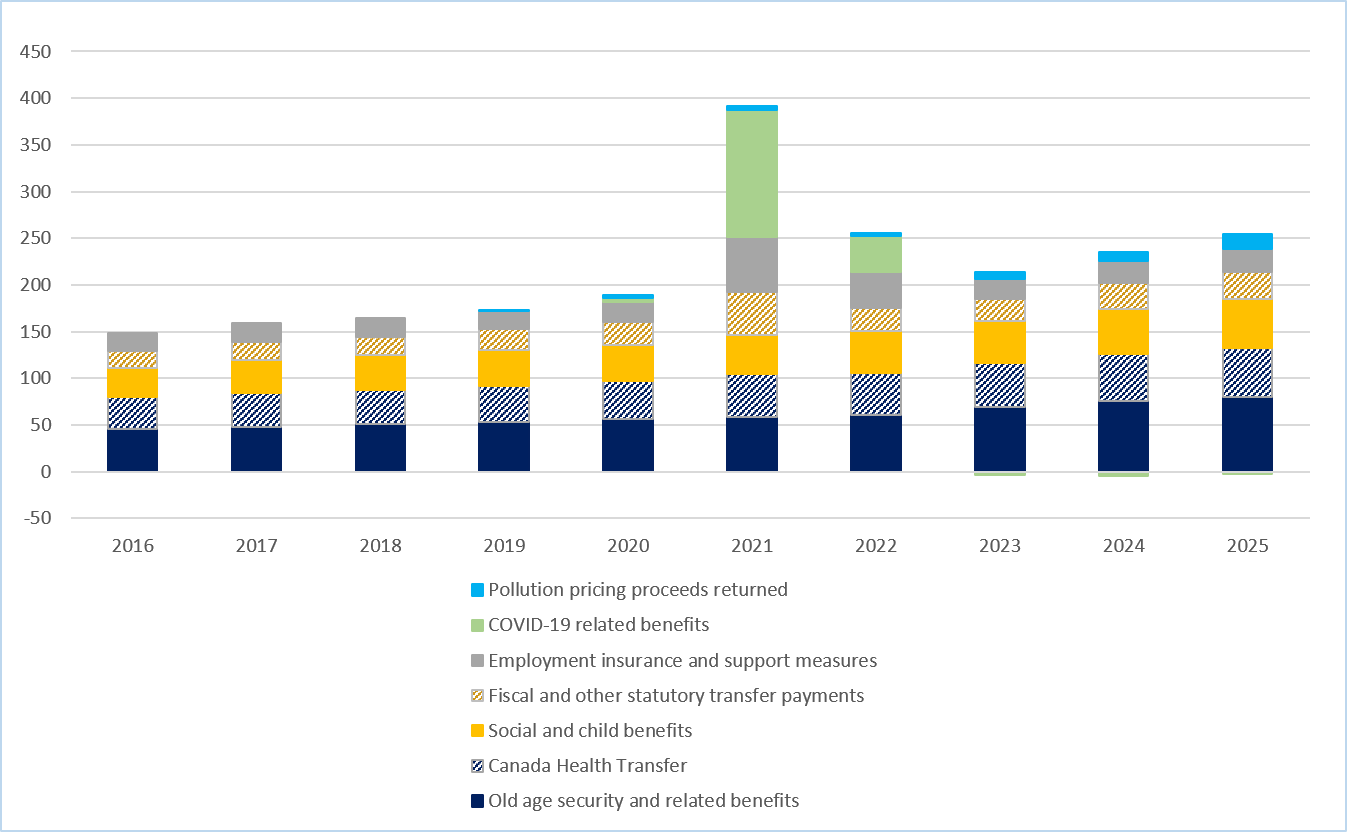
Figure 3 illustrates the trends in the growth and composition of major statutory transfer payment programs since 2016. Major transfers to individuals include Employment Insurance and Old Age Security benefits. Major transfers to other orders of government include the Canada Health Transfer, fiscal payments (i.e., equalization payments) and pollution pricing proceeds returned.
Figure 3 – Statutory Transfer Payments, 2016–2025 ($ billions)
Note: The fiscal year runs from 1 April through 31 March of the following year.
Source: Figure prepared by the Library of Parliament based on data obtained from Government of Canada, Public Accounts of Canada.
Voted Transfer Payments
The government has created numerous grant and contribution transfer payments. They are included in the Public Accounts of Canada as “Other transfer payments.” Examples of grants include apprenticeship grants and grants to support Canada’s tobacco strategy. Examples of contributions include support for First Nations elementary and secondary educational advancement and contributions under the Strategic Response Fund.
The accountability and reporting requirements for grants and contributions differ. According to the Treasury Board of Canada Secretariat’s (TBS) Policy on Transfer Payments:
- “A grant is a transfer payment subject to pre-established eligibility and other entitlement criteria. A grant is not subject to being accounted for by a recipient nor normally subject to audit by the department. The recipient may be required to report on results achieved.”
- “A contribution is a transfer payment subject to performance conditions specified in a funding agreement. A contribution is to be accounted for and is subject to audit.”
There are various forms of contributions, including non-repayable contributions, conditionally or unconditionally repayable contributions, or a combination thereof. Some contribution agreements require repayments based on agreed-upon annual amounts; alternatively, some conditional repayments are based on recipients’ revenue, i.e., recipients are expected to repay the contribution only when certain income or profitability criteria have been met.
Administration of Voted Transfer Payment Programs
Funding for a voted transfer payment program is usually announced in the Minister of Finance’s budget and approved by Parliament in the estimates process or in legislation outlining a program’s parameters.
Under the Policy on Transfer Payments, the Treasury Board is responsible for approving a new transfer payment program and departments and agencies are responsible for administering the funds. To request funds for a new program, a department or agency prepares a Treasury Board Submission, which includes the proposed program’s authorities and terms and conditions, as well as its policy goals, expected results, types of transfer payments and repayments risks, official languages implications and Gender-based Analysis Plus (GBA Plus) considerations.
Once a transfer payment program has been approved and receives funding, departments and agencies solicit or receive applications to allocate the funds. They assess applications against established criteria to ensure the eligibility of applicants, the relevance and viability of proposals, implementation timelines, and in some cases, GBA Plus considerations.
Departments and agencies then decide how to allocate funding to recipients consistent with the program’s terms and conditions. Some programs provide full funding up front, while others require recipients to submit expense claims that must be approved before they are reimbursed. Additionally, some programs may use funding agreements with recipients that outline how the funding is to be used.
As noted earlier, grant recipients usually have fewer accountability and reporting requirements than contribution recipients. In addition, departments and agencies may audit the recipients of contributions to ensure that a program’s terms and conditions have been met and the funds have been put to proper use.
Departments and agencies are responsible for monitoring and reporting program results, as well as undertaking evaluations every five years of the relevance and effectiveness of grant and contribution programs. The evaluations should also assess the impact of programs on diverse groups.
Reporting
Departments and agencies set out their planned spending on grant and contribution programs in the main estimates and supplementary estimates. They also proactively disclose information on grants and contributions awarded under these programs. They then report on their actual expenditures in the Public Accounts of Canada. The public accounts also identify recipients of grants and contributions of $100,000 or more during the fiscal year. Finally, these organizations report on the results of their programs in their departmental results reports; this information can also be found on GC Infobase.
Administrative Burden
An independent report commissioned by the government in 2006 found that recipients of grants and contributions were experiencing significant financial and administrative burdens in applying for funding and complying with program requirements. Subsequent research and consultations regarding the impact of federal policies and practices on non-profits, together with studies on the effects of unrestricted funding, have similarly found that many Indigenous and non-profit organizations that rely on grant and contribution programs have been adversely affected by such burdens.
In an effort to reduce these burdens, the current TBS Guideline on the Directive on Transfer Payments includes specific references to the “reduction of administrative requirements,” “standardization of administrative processes,” and the “use of single funding agreements to cover transfer payments from multiple programs.”
Further Reading
Pu, Shaowei. The Parliamentary Financial Cycle. Publication no. 2025-10-E. Library of Parliament, 1 May 2025.
By Dillan Theckedath, Library of Parliament
This publication is based on a previous Library of Parliament publication by Alex Smith and Dillan Theckedath.
Categories: Economics and finance, Government, Parliament and politics