
Governments finance the goods and services that they provide in various ways, including through taxation, investment and borrowing activities.
The first of these activities – taxation – can take several forms. In Canada, sources of funds that help to finance federal initiatives include personal income taxes, corporate income taxes, consumption taxes and social security contributions.
This HillNote provides information about the revenue, rates and rationale relating to federal personal income taxes in Canada. Other HillNotes discuss corporate income taxes, consumption taxes and social security contributions.
Revenue
Figure 1 shows that, in 2025–2026, personal income tax revenue totaled $247.7 billion and represented 38.3% of total federal tax revenue and social security contributions.
Figure 1 – Federal Tax Revenue and Social Security Contributions, 2025–2026 ($ billions)

Notes
“Social security contributions” are Canada Pension Plan and Quebec Pension Plan (CPP and QPP) contributions, and Employment Insurance premiums. The QPP operates exclusively in Quebec, with the CPP operating in the rest of Canada. For the purposes of this figure, QPP contributions are deemed “federal” and combined with contributions to the CPP. CPP and QPP contributions reflect the sum of the second, third, and fourth quarters of 2025 and the first quarter of 2026, consistent with the federal fiscal year (1 April 2025 to 31 March 2026).
“Consumption taxes” are the Goods and Services Tax, the Harmonized Sales Tax, energy taxes, customs import duties, other excise taxes and duties, and pollution pricing proceeds.
“Other taxes and revenue” are non-resident income taxes, revenue from federal enterprise Crown corporations and similar entities, net foreign exchange revenue and revenue from other programs.
Sources: Figure prepared by the Library of Parliament using data obtained from Government of Canada, “Revenues, expenses and accumulated deficit, as per the Public Accounts of Canada,” Open Government Portal, 2025-2026 data file (for all values except Canada Pension Plan and Quebec Pension Plan contributions); and Statistics Canada, “Table 10-10-0015-01: Statement of government operations and balance sheet, government finance statistics (x1,000,000),” Database, accessed 16 November 2026 (for Canada Pension Plan and Quebec Pension Plan contributions only).
As shown in Figure 2, Canada’s personal income tax revenue in 2024, expressed as a percentage of gross domestic product, was higher than the average for Organisation for Economic Co‑operation and Development (OECD) countries and the highest among the Group of Seven, or G7, countries.
Figure 2 – Revenue from Personal Income Tax and Other Taxes and Contributions, as a Percentage of Gross Domestic Product (All Levels of Government), in Group of Seven Countries and the Average for Organisation for Economic Co-operation and Development Countries, 2024
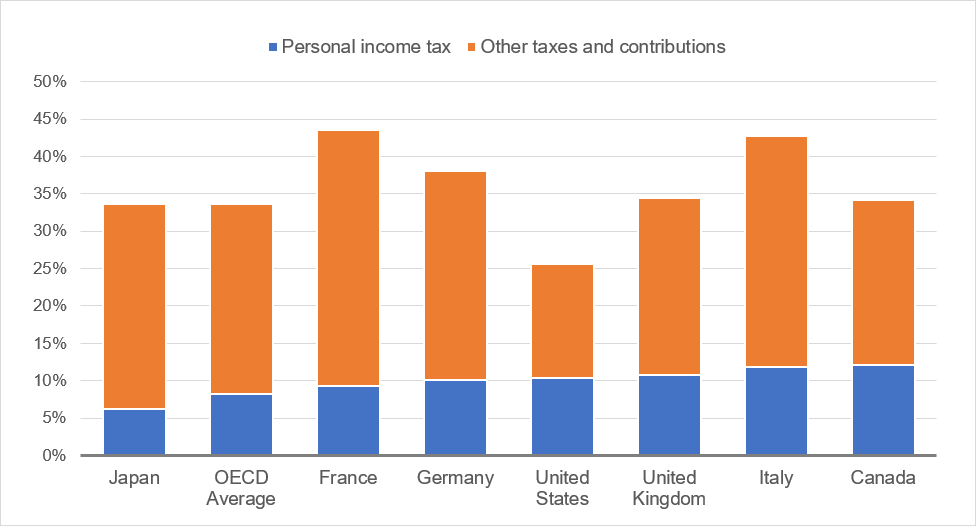
Note: “Other taxes and contributions” includes corporate income taxes, social security contributions, payroll and workforce taxes, property taxes, taxes on goods and services, and other taxes.
The data for Japan and the OECD average are for 2023, the most recent year for which they are available.
Source: Figure prepared by the Library of Parliament using data obtained from Organisation for Economic Co-operation and Development, “Global Revenue Statistics – Comparative tax revenues,” Database, accessed 3 September 2026.
Rates
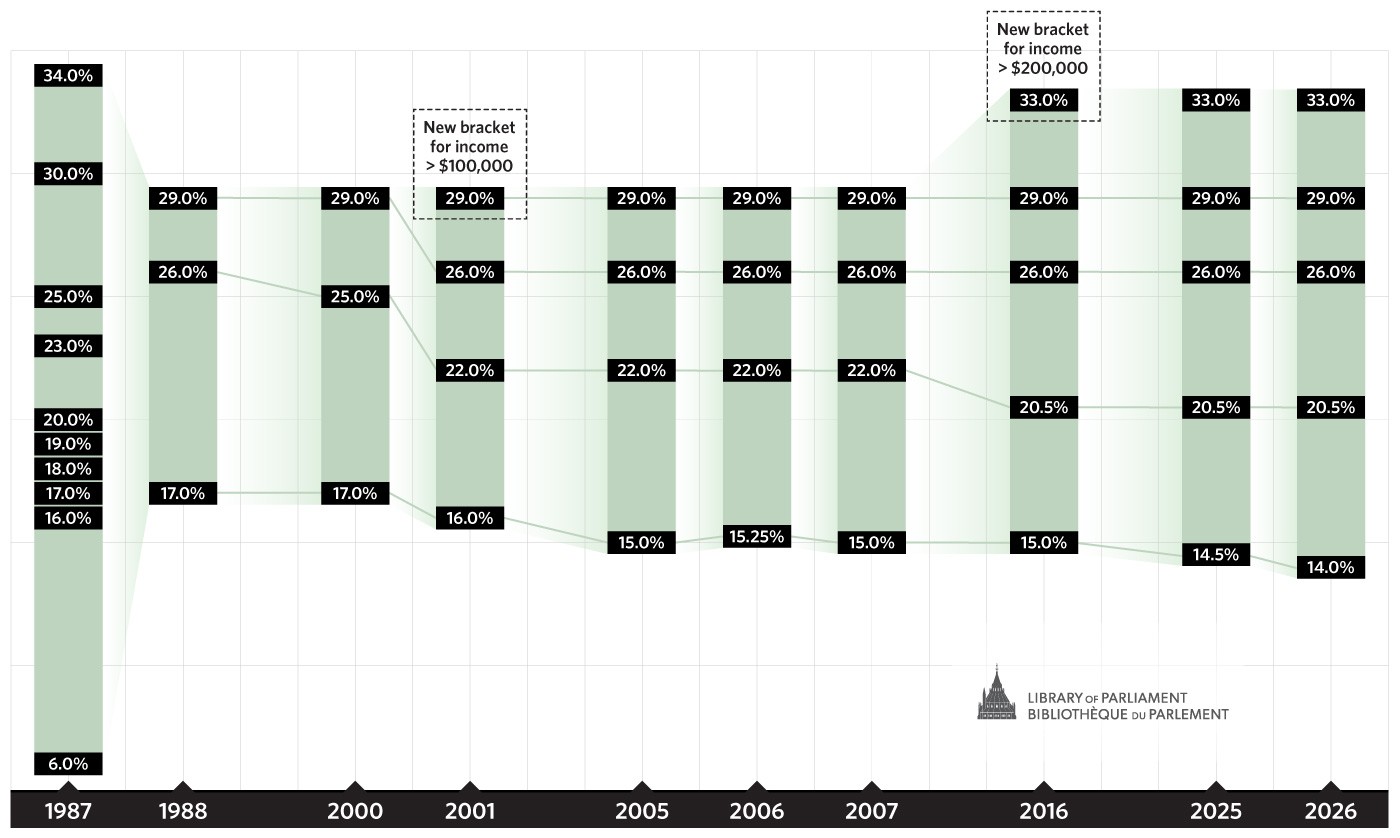
Over time, the number of federal personal income tax brackets, each bracket’s income thresholds and the tax rates applicable to those brackets have changed. Figure 3 shows changes in the number of personal income tax brackets and their respective rates since 1987.
Figure 3 – Personal Income Tax Brackets and Rates in Canada, 1987–2026
Source: Figure prepared by the Library of Parliament using data obtained from Canada Revenue Agency, All years tax rates and income brackets.
Federal personal income tax rates for the 2026 taxation year are as follows:
- 14.0% on the first $58,523 of taxable income;
- 20.5% on taxable income between $58,523.01 and $117,045;
- 26.0% on taxable income between $117,045.01 and $181,440;
- 29.0% on taxable income between $181,440.01 and $258,482; and
- 33.0% on taxable income exceeding $258,482.
The income thresholds for tax brackets, as well as certain other amounts within the personal income tax system, are indexed to inflation every year.
In Canada, various sources of domestic and foreign income are taxed, although individuals can claim a tax credit for taxes paid in foreign countries. Taxable income includes income from employment or self-employment, pensions, rental properties, royalties, financial investments and numerous government benefits. Certain other sources of income are not taxed, such as most lottery winnings, gifts, inheritances, and selected life insurance and government benefits.
Unlike in some other countries, in Canada, personal income taxes are generally calculated based on individual – rather than family – income. While Indigenous Peoples in Canada are subject to the same income tax rules as other residents of Canada, some individuals who are registered or entitled to be registered under the Indian Act may qualify for specific tax exemptions outlined in section 87 of the Act. From a personal income tax perspective, these exemptions apply to income earned on a reserve or that is considered to be earned on a reserve.
Taxpayers are entitled to earn income tax-free up to a defined amount known as the basic personal amount, and those aged 65 and older can also claim the age amount if their income does not exceed a specific amount. Moreover, taxpayers may claim an amount for a spouse, common-law partner or eligible dependant. This amount, which is equal in value to the basic personal amount, is reduced on a dollar-for-dollar basis by the net income of the spouse, common-law partner or dependant.
As well, the personal income tax system contains credits and deductions that recognize a variety of personal expenses that may be incurred during the year. These expenses include certain costs relating to child care, employment and medical expenses; union dues; contributions to pension plans and the Employment Insurance program; and charitable donations. Additionally, credits and deductions are available to certain classes of individuals, such as those with disabilities, volunteer firefighters, search-and-rescue volunteers, and Northern residents.
Since 2007, spouses or common-law partners have been able to split their eligible pension income, with up to 50% of that income allocated to the spouse or common-law partner with the lower income.
The federal dividend tax credit can be claimed by investors to reduce income taxes payable on the dividends that they receive from taxable Canadian corporations.
Finally, since 1972, capital gains – which occur when an asset’s sale price exceeds its purchase price – have been taxed. Since 18 October 2000, 50% of this capital gain has been taxed; this rate has varied over time. Budget 2024 announced an increase in the capital gains inclusion rate to 66.67%. However, the federal government cancelled the proposed increase on 21 March 2025.
Rationale
The Government of Canada first imposed a tax on personal income in 1917 through the Income War Tax Act, whose purpose was to finance participation in the First World War. Previously, almost all federal revenue had been derived from tariffs, excise taxes and revenue from postal services.
The personal income tax system is one policy instrument that governments use to redistribute income among tax filers. In theory, that system could affect decisions that individuals make about the quantity of labour they supply and the amount of money they save or spend.
Changes in personal income tax rates might influence individuals’ decisions about labour supply, that is, decisions about how many hours to work. For example, some people might choose to work more to compensate for a reduction in take-home pay. Alternatively, they might decide to work less because the lower amount of take-home pay makes non-work activities more attractive. That said, individuals do not always have complete control over the number of hours they work. In many instances, employers and collective agreements determine the number of working hours.
Similarly, saving and spending decisions may be influenced by changes in personal income tax rates. For instance, when income tax rates rise, some individuals might save more to compensate for the lower after-tax rate of return on their income-producing investments. Alternatively, they might save less because a reduction in after-tax investment income could encourage them to spend now rather than save for later consumption. However, changes in personal income tax rates may have little or no effect on saving and spending decisions. For example, some individuals may base their saving and spending decisions on other factors, such as a desire to maintain a lifestyle similar to that of their peers.
Empirical studies have not demonstrated a consistent and significant relationship between the personal income tax system and labour supply or saving and spending decisions.
Additional Resources
Department of Finance Canada. Report on Federal Tax Expenditures – Concepts, Estimates and Evaluations 2026, 2026.
Office of the Parliamentary Budget Officer. Ready Reckoner.
Organisation for Economic Co-operation and Development, Taxing Wages 2026: The Progressivity of Labour Taxation in OECD Countries, 22 April 2026.
By Simon Richards and Brett Stuckey, Library of Parliament
Revised by Michaël Lambert-Racine, Library of Parliament
Categories: Economics and finance