
In March 2018, Canada and 10 other jurisdictions in the Asia–Pacific region signed the Comprehensive and Progressive Agreement for Trans-Pacific Partnership (CPTPP or the Agreement).
Since then, several jurisdictions have expressed an interest in acceding to the Agreement, and those that make a formal request to do so must complete the steps in the CPTPP’s accession process in order to accede. To date, the United Kingdom alone has acceded to the Agreement. Among the other jurisdictions that have requested accession, the process has formally started only for Costa Rica and Uruguay.
Existing and Potential Members
In August 2026, and as shown in Figure 1, a number of jurisdictions had either acceded to the Agreement, made a formal accession request or informally indicated an interest in acceding to the Agreement.
Figure 1 – Existing and Potential Members of the Comprehensive and Progressive Agreement for Trans-Pacific Partnership (as of 27 August 2026)
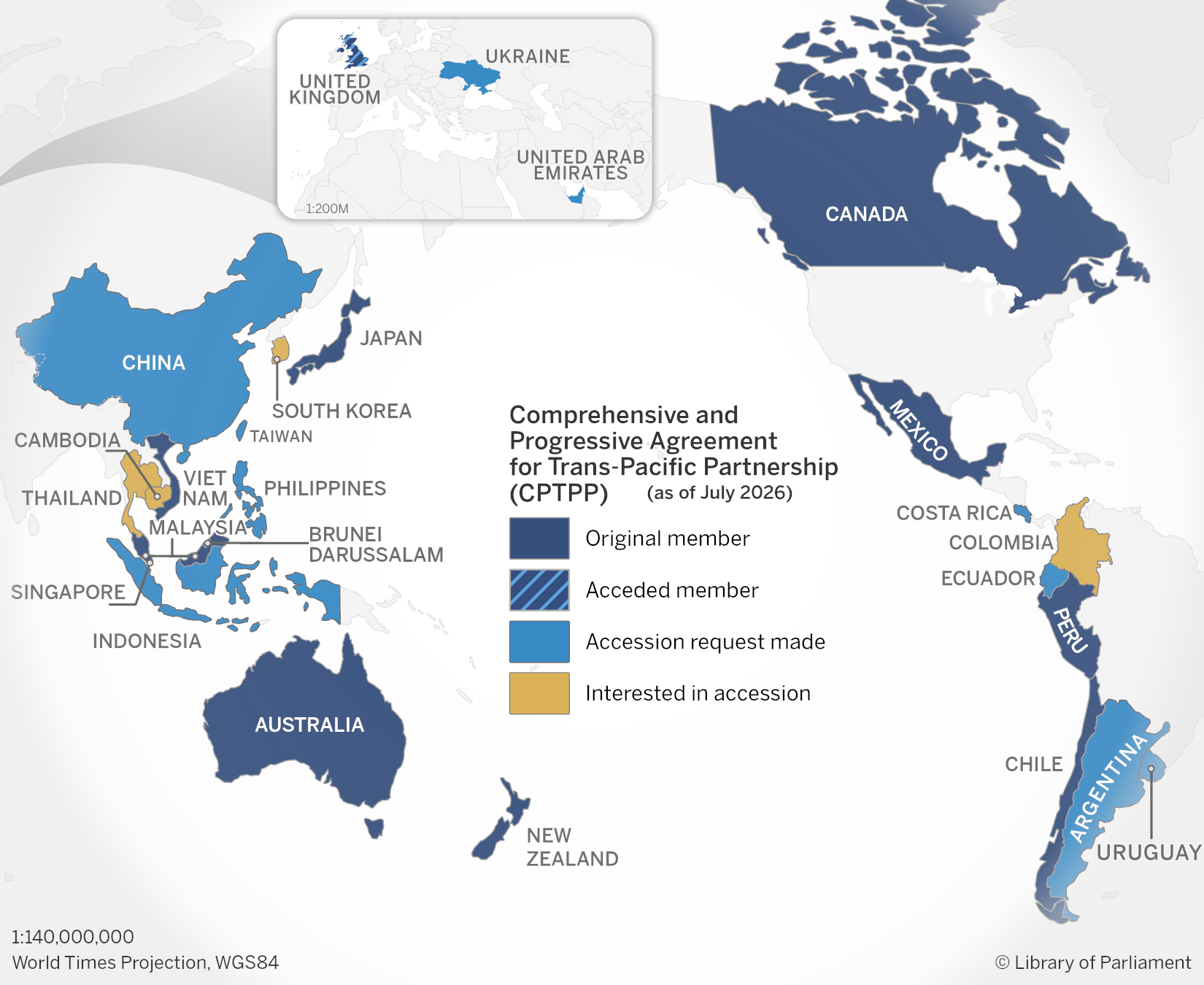
Note: “Accession request made” refers to jurisdictions that have formally requested accession to the Comprehensive and Progressive Agreement for Trans-Pacific Partnership (CPTPP). “Interested in accession” refers to jurisdictions that have indicated an interest in acceding to the CPTPP, but that have not made a formal request.
Sources: Map prepared by the Library of Parliament, 2026, using data from Government of Canada, CPTPP explained; Asia Pacific Foundation of Canada, CPTPP Portal; and Natural Earth, 1:10m Cultural Vectors and 1:10m Physical Vectors, version 5.1.1. The following software was used: Esri, ArcGIS Pro, version 3.7.1.
Accession Process
The CPTPP Commission (the Commission), which comprises representatives from all CPTPP members, established the process for acceding to the Agreement.
The accession process, which relies on consensus and requires bilateral and multilateral consultations, follows the steps outlined in Figure 2. The process is consistent with the Auckland Principles, which assess the extent to which a jurisdiction:
- is prepared to meet the CPTPP’s “high standards”;
- complies with existing trade commitments; and
- recognizes that CPTPP members make decisions about the Agreement by consensus.
Figure 2 – Steps in the Comprehensive and Progressive Agreement for Trans-Pacific Partnership Accession Process

Descriptive text
- Accession request: The jurisdiction seeking to accede to the Comprehensive and Progressive Agreement for Trans-Pacific Partnership (the Agreement) submits an accession request to the Agreement Depositary (New Zealand).
- Commission decision: Within a “reasonable period of time” after an accession request is submitted, the Agreement Commission decides by consensus whether to begin the accession process.
- Accession working group creation: If the Commission decides to begin the accession process, it establishes an accession working group (working group) responsible for negotiating the jurisdiction’s accession.
- Compliance plan and market access offers: The jurisdiction provides the working group with its plan to comply with the obligations in the Agreement. Within 30 days after the working group’s first meeting, it submits its market access offers.
- Negotiations: Negotiations take place as part of a bilateral process and through the working group. When negotiations are finalized, the working group approves a report that outlines the terms and conditions for accession.
- Invitation: The Commission decides by consensus to invite the jurisdiction to accede to the Agreement. The jurisdiction generally has six months to confirm that it accepts the terms and conditions for accession.
- Ratification: The jurisdiction and the members to the Agreement complete their respective ratification procedures, which are needed to implement the terms and conditions for accession.
- Accession: Unless the Commission decides to make an alternative arrangement, the jurisdiction accedes to the Agreement either 60 days after notifying the Depositary that its ratification process is complete or on the date by which all members to the Agreement have given notification that their ratification processes are complete.
Source: Figure prepared by the Library of Parliament using data obtained from Government of Canada, Comprehensive and Progressive Agreement for Trans-Pacific Partnership (CPTPP) – Accession Process.
United Kingdom’s Accession
Accession request: Starting in July 2018, the United Kingdom held informal discussions with all original CPTPP members about its interest in acceding to the Agreement. On 1 February 2021, the United Kingdom submitted its accession request to New Zealand, which is the CPTPP Depositary.
Commission decision and creation of accession working group (AWG): On 2 June 2021, the Commission decided to proceed with the United Kingdom’s accession request and establish an AWG.
Compliance plan and market access offers: On 28 and 29 September 2021, the AWG convened its first meeting to examine how the United Kingdom would comply with the CPTPP’s obligations. On 3 and 18 March 2022, the United Kingdom submitted its initial market access offers.
Negotiations: On 31 March 2023, the original CPTPP members and the United Kingdom concluded accession negotiations through the AWG and bilaterally. On 14 July 2023, the AWG approved its report to the Commission, which summarized the negotiations and contained a draft accession protocol outlining the terms and conditions for the United Kingdom to accede to the Agreement.
Invitation: On 16 July 2023, the Commission approved the United Kingdom’s accession to the Agreement, and the United Kingdom and the original CPTPP members signed the accession protocol.
Ratification: After signing the accession protocol, the United Kingdom and the original CPTPP members began their respective domestic procedures to ratify the accession protocol. On 16 May 2024, the United Kingdom became the fourth jurisdiction to ratify the protocol.
Accession: On 15 December 2024, which was 60 days after six CPTPP members ratified the accession protocol, the United Kingdom became a CPTPP member and the Agreement began to govern its trade with these six members. On 6 May 2026, Canadian legislative amendments implementing the accession protocol received Royal Assent. Canada’s ratification of the protocol will enter into force on 1 September 2026, completing the accession process for the United Kingdom.
Current Accession Requests and Some Potential Implications
Underscoring that the CPTPP was designed to allow new accessions, the Commission stated that accessions ensure that the CPTPP “remains a dynamic and living Agreement.” Because of its high standards and consensus-based accession process, some jurisdictions may not be successful in their attempt to accede to the Agreement.
Table 1 provides selected information about jurisdictions that had formally requested accession to the CPTPP as of August 2026.
Table 1 – Selected Information About Formal Requests to Accede to the Comprehensive and Progressive Agreement for Trans-Pacific Partnership and Relevant Trade Agreements (as of 27 August 2026)
| Jurisdiction | Accession Request | Accession Working Group Established | Trade Agreement |
| United Kingdom | 1 February 2021 | 2 June 2021 | Canada–United Kingdom Trade Continuity Agreement |
| China | 16 September 2021 | – | none |
| Taiwan | 22 September 2021 | – | none |
| Ecuador | 17 December 2021 | – | Canada–Ecuador Free Trade Agreement (signed, but not in force) |
| Costa Rica | 10 August 2022 | 28 November 2024 | Canada–Costa Rica Free Trade Agreement (modernization negotiations ongoing) |
| Uruguay | 1 December 2022 | 21 November 2025 | Canada–Mercosur Free Trade Agreement (negotiations ongoing) |
| Ukraine | 5 May 2023 | – | Canada–Ukraine Free Trade Agreement |
| Indonesia | 25 September 2024 | – | Canada–Indonesia Comprehensive Economic Partnership Agreement (signed, but not in force)
Canada–Association of Southeast Asian Nations (ASEAN) Free Trade Agreement (negotiations ongoing) |
| Philippines | August 2025 | – | Canada–Philippines Free Trade Agreement (negotiations ongoing)
Canada–ASEAN Free Trade Agreement (negotiations ongoing) |
| United Arab Emirates | 22 August 2025 | – | Canada–United Arab Emirates Comprehensive Economic Partnership Agreement (negotiations concluded) |
| Argentina | 3 June 2026 | – | Canada–Mercosur Free Trade Agreement (negotiations ongoing) |
Notes: The day on which the Philippines submitted its accession request to the CPTPP Depositary is not publicly available.
Mercosur is a South American trading bloc that includes Argentina, Bolivia, Brazil, Paraguay and Uruguay.
Source: Government of Canada, Canada’s international trade and investment agreements, Database, accessed on 20 August 2026.
One objective of Canada’s Indo-Pacific Strategy is to “strengthen and expand the CPTPP.” About 75% of participants in the Government of Canada’s 2019 public consultations concerning CPTPP accession requests generally supported accessions to the Agreement.
Amidst rising trade and other uncertainties, Canada has taken action to meet its export diversification goal. Supporting accession requests by like-minded jurisdictions that meet the CPTPP’s accession requirements could help achieve that objective.
In early 2025, participants in Global Affairs Canada’s public consultations expressed support for Costa Rica’s potential accession to the CPTPP. Although such consultations have not been held for Uruguay, public consultations have identified support for a free trade agreement between Canada and the Southern Common Market (Mercosur), of which Uruguay is a member.
Moreover, accession requests from China and Taiwan have prompted discussions about possible implications for the CPTPP members. The Asia Pacific Foundation of Canada observes that the members may face a “difficult dilemma” in assessing these accession requests, including because of ongoing geopolitical tensions.
As well, Canada’s relationship with the United States could be affected if China were to accede to the CPTPP. For instance, the Canada–United States–Mexico Agreement can be terminated if a party enters into a trade agreement with a jurisdiction that has a non-market economy.
Additional Resources
Alschner, Wolfgang. Is the CPTPP Ready to Meet the Moment? Asia Pacific Foundation of Canada, 25 November 2025.
Stephens, Hugh. Canada’s Year as CPTPP Chair: A Report Card. Asia Pacific Foundation of Canada, 11 December 2024.
The Economist Intelligence Unit. What’s next for the CPTPP? White paper, 2022.
Ufimtseva, Anastasia et al. International Trade & Investment Report: The Impact of the CPTPP on Trade Between Canada and the Asia Pacific. Asia Pacific Foundation of Canada, 26 November 2024.
Varghese, Peter. The CPTPP dilemma: Economic merit versus geopolitical calculation. Lowy Institute, 27 May 2025.
By Bashar Abu Taleb and Anne-Marie Therrien-Tremblay, Library of Parliament
Categories: Business, industry and trade, International affairs and defence